Earth Science
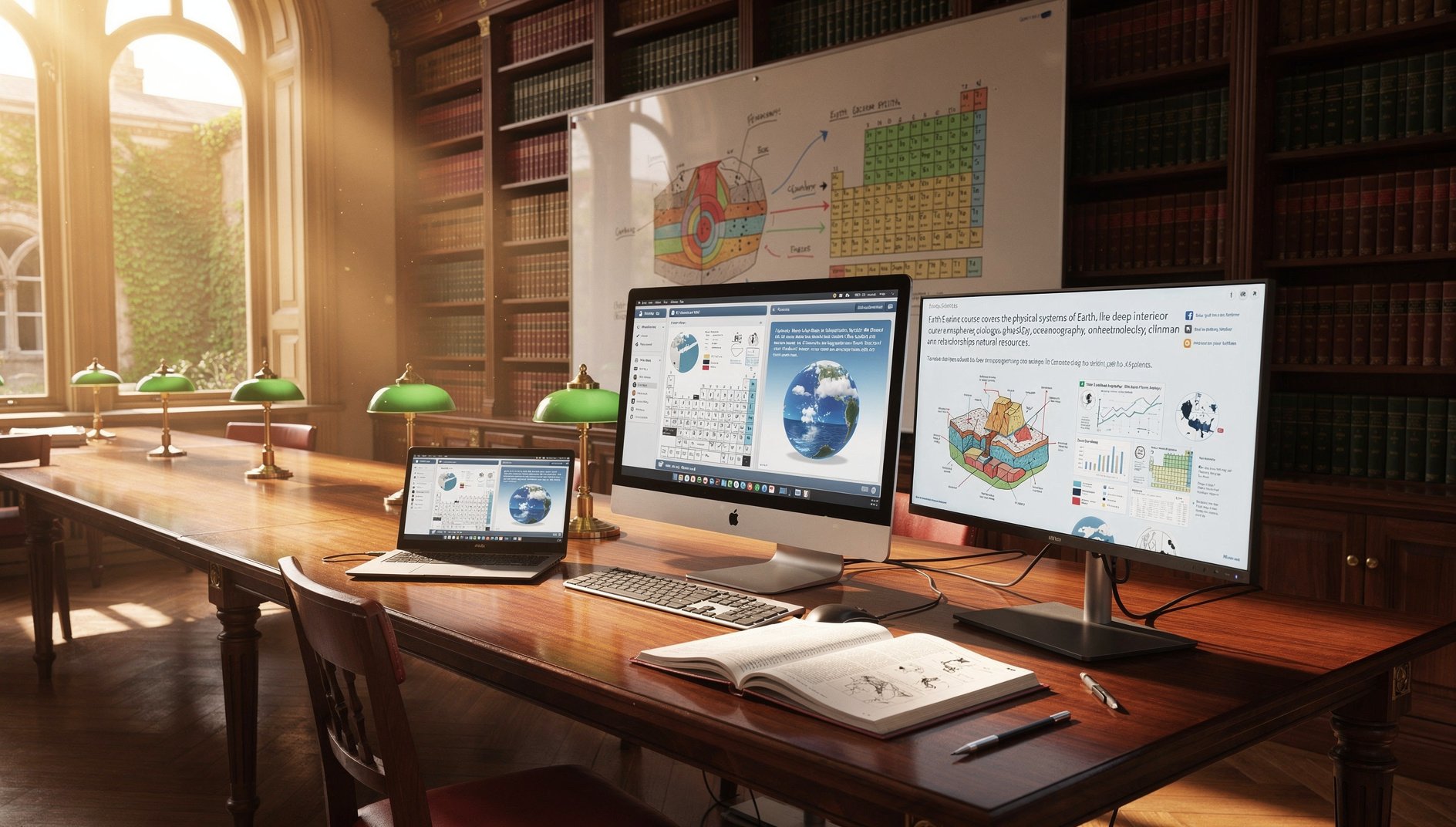
The Earth Science course covers the physical systems of Earth — from the deep interior to the outer atmosphere — giving learners a comprehensive foundation in geology, oceanography, meteorology, climate, and the human relationship with natural resources.
Who Should Take This
Ideal for high-school and introductory college students preparing for Earth science coursework or standardized tests, as well as curious adults who want a rigorous grounding in how Earth's systems work, change over time, and interact with human society.
What's Covered
1Plate Tectonics
2Rocks and the Rock Cycle
3Minerals
4Weathering and Erosion
5Volcanoes and Earthquakes
6Geologic Time and Fossils
7Oceanography
8Atmospheric Structure and Weather
9Climate and Climate Change
10Water Cycle and Soil
11Natural Resources
What's Included in AccelaStudy® AI
Adaptive Knowledge Graph
Practice Questions
Lesson Modules
Console Simulator Labs
Exam Tips & Strategy
13 Activity Formats
Course Outline
1Plate Tectonics 6 topics
Describe the structure of Earth's interior including the crust, mantle, outer core, and inner core and explain how seismic wave data provided evidence for this layered model
Describe the theory of plate tectonics including the concept of lithospheric plates, asthenosphere convection as a driving mechanism, and the historical development from continental drift to modern plate theory
Identify the three types of plate boundaries — divergent, convergent, and transform — and describe the tectonic processes and landforms associated with each boundary type
Apply the concept of seafloor spreading to explain the formation of mid-ocean ridges, magnetic striping patterns, and the age distribution of oceanic crust away from spreading centers
Apply plate boundary interactions to explain the distribution of volcanoes and earthquakes globally including subduction zones, hot spots, and rift valleys
Analyze how lines of evidence including fossil distribution, matching coastlines, paleoclimate data, and rock type correlation support the theory of continental drift and plate tectonics
2Rocks and the Rock Cycle 6 topics
Describe the three rock types — igneous, sedimentary, and metamorphic — and identify the key characteristics and examples of each type
Distinguish between intrusive and extrusive igneous rocks based on cooling rate, crystal size, and texture, and identify common examples such as granite, basalt, obsidian, and pumice
Describe the formation of sedimentary rocks through weathering, erosion, deposition, compaction, and cementation, and identify clastic, chemical, and organic sedimentary rock types
Describe how heat and pressure transform existing rocks into metamorphic rocks and distinguish foliated from non-foliated metamorphic textures with examples such as slate, schist, marble, and quartzite
Apply the rock cycle model to trace the pathways by which any rock type can be transformed into any other type through geologic processes including melting, cooling, erosion, and metamorphism
Analyze how rock type and texture can be used to infer the geologic history and environmental conditions of formation for a given rock sample
3Minerals 5 topics
Define a mineral and list the five defining properties — naturally occurring, inorganic, solid, definite crystalline structure, and specific chemical composition — distinguishing minerals from rocks and organic materials
Identify physical properties used to identify minerals including hardness (Mohs scale), cleavage versus fracture, luster, color, streak, specific gravity, and special properties such as magnetism and fluorescence
Apply mineral identification techniques to distinguish common rock-forming minerals including quartz, feldspar, mica, calcite, halite, and olivine based on observable physical properties
Apply knowledge of mineral properties and formation environments to explain the economic uses of minerals including ore minerals, industrial minerals, and gemstones
Analyze the relationship between silicate mineral structure — isolated tetrahedra, chains, sheets, and frameworks — and macroscopic properties such as cleavage direction and chemical reactivity
4Weathering and Erosion 5 topics
Distinguish between mechanical and chemical weathering processes and describe specific examples including frost wedging, abrasion, oxidation, hydrolysis, carbonation, and biological weathering
Describe the agents of erosion — water, wind, ice, and gravity — and explain the landforms and sediment deposits each agent creates through transportation and deposition
Apply the concept of differential weathering to explain why different rock types and mineral compositions weather at different rates and how this shapes landscape topography
Apply understanding of erosion and deposition processes to identify and explain the formation of specific landforms including river deltas, alluvial fans, moraines, sand dunes, and sea stacks
Analyze how climate, rock type, slope, and vegetation interact to determine weathering and erosion rates, and evaluate how human land-use changes accelerate or mitigate these processes
5Volcanoes and Earthquakes 6 topics
Describe the three main volcano types — shield, composite (stratovolcano), and cinder cone — and explain how magma composition and eruption style determine which type forms
Describe seismic wave types including P-waves, S-waves, and surface waves and explain how their behavior during propagation is used to locate earthquake epicenters and study Earth's interior
Explain how the Richter and moment magnitude scales measure earthquake energy release, how intensity scales such as Modified Mercalli measure ground shaking effects, and why the two types of measurement differ
Apply tectonic setting knowledge to predict where volcanoes and earthquakes are likely to occur and explain why the Pacific Ring of Fire concentrates a disproportionate share of global seismic and volcanic activity
Apply knowledge of seismic hazards to explain mitigation strategies including building codes, early warning systems, tsunami preparedness, and land-use planning in high-risk zones
Analyze the constructive and destructive effects of volcanic activity including soil fertility, island formation, climate forcing from aerosols, lahars, pyroclastic flows, and lava flows
6Geologic Time and Fossils 6 topics
Describe the principles of relative dating including superposition, original horizontality, cross-cutting relationships, and inclusions, and apply them to determine the sequence of geologic events in a rock sequence
Describe radiometric dating including radioactive decay, half-life, and parent-daughter isotope ratios, and explain why different isotope systems are used for different age ranges
Identify the major eons, eras, and periods of the geologic time scale and describe the biological and tectonic events that define their boundaries
Apply the concept of index fossils to correlate rock layers across geographic regions and estimate the ages of sedimentary strata in the absence of radiometric data
Apply understanding of fossilization conditions to explain why the fossil record is incomplete and which organisms and environments are over- or under-represented in the geologic record
Analyze the causes and consequences of mass extinction events including the end-Cretaceous impact event, end-Permian volcanic activity, and the role of rapid environmental change in triggering biotic crises
7Oceanography 6 topics
Describe the vertical zones of the ocean including the photic, aphotic, and hadal zones, and explain how temperature, pressure, salinity, and light vary with depth
Describe the global ocean conveyor belt (thermohaline circulation) and explain how density differences driven by temperature and salinity differences drive deep-ocean circulation and heat redistribution
Explain the causes of tides including gravitational attraction of the Moon and Sun, the difference between spring and neap tides, and tidal patterns in different coastal settings
Apply knowledge of surface ocean currents — including the role of wind, Coriolis effect, and continental boundaries — to explain the gyre systems and their influence on regional climates
Apply understanding of ocean-atmosphere interaction to explain El Niño and La Niña events, their teleconnections, and their effects on precipitation and temperature patterns worldwide
Analyze the threats to ocean ecosystems including ocean acidification, warming, overfishing, hypoxic dead zones, and plastic pollution, and evaluate the interconnections among these stressors
8Atmospheric Structure and Weather 6 topics
Identify the layers of Earth's atmosphere — troposphere, stratosphere, mesosphere, thermosphere, and exosphere — and describe the temperature profile, composition, and key phenomena in each layer
Describe the formation of high and low pressure systems, the role of the Coriolis effect in wind deflection, and how pressure gradients drive global wind belts including trade winds, westerlies, and polar easterlies
Describe the types of weather fronts — cold, warm, stationary, and occluded — and explain the characteristic cloud sequences, precipitation patterns, and temperature changes associated with each front type
Apply knowledge of atmospheric lifting mechanisms, instability, and moisture content to explain the formation of thunderstorms, tornadoes, and tropical cyclones (hurricanes) including the conditions that intensify or dissipate them
Apply understanding of weather instruments and data — including barometers, radiosondes, weather satellites, and Doppler radar — to explain how modern weather forecasting works and its limitations
Analyze the relationship between urban heat islands, air quality, and local weather modification and evaluate how landscape alteration and pollution interact with natural atmospheric processes
9Climate and Climate Change 6 topics
Distinguish weather from climate and describe the major factors that control climate including latitude, altitude, proximity to oceans, prevailing winds, and ocean currents
Describe the greenhouse effect mechanism, identify the major greenhouse gases including water vapor, carbon dioxide, methane, and nitrous oxide, and explain how enhanced greenhouse forcing drives global warming
Identify evidence for past climate change from proxy records including ice cores, tree rings, coral skeletons, and pollen analysis, and explain what these records reveal about natural climate variability over millennia
Apply understanding of climate feedbacks — including ice-albedo, water vapor amplification, permafrost methane release, and cloud feedbacks — to explain why small forcing changes can lead to large climate responses
Apply Koppen climate classification to identify tropical, dry, temperate, continental, and polar climate zones and explain the atmospheric circulation and geographic factors that produce each zone
Analyze the projected consequences of continued anthropogenic climate change including sea-level rise, shifting biomes, extreme weather intensification, and ocean acidification, and evaluate the scientific consensus on attribution
10Water Cycle and Soil 6 topics
Describe the water cycle including evaporation, transpiration, condensation, precipitation, surface runoff, infiltration, and groundwater flow, and identify the main reservoirs where water is stored
Describe the structure of groundwater systems including the water table, aquifers (confined and unconfined), and aquitards, and explain how wells, springs, and artesian systems function
Describe soil formation through weathering of parent material and the five factors controlling soil development — climate, organisms, relief, parent material, and time — and identify the horizons of a typical soil profile
Apply the concept of a watershed and drainage basin to explain how land surface features determine where precipitation flows and how human activities in upstream areas affect downstream water quality and quantity
Apply knowledge of soil texture, structure, and organic content to explain soil fertility, water-holding capacity, and erosion susceptibility, and describe conservation practices that maintain healthy soils
Analyze the threats to freshwater resources including groundwater overdraft, aquifer contamination, salinization, and changes in precipitation patterns, and evaluate the sustainability of current water use in different regions
11Natural Resources 5 topics
Distinguish between renewable and non-renewable natural resources and categorize major resource types including fossil fuels, metals, water, soil, timber, solar, wind, and geothermal energy
Describe the formation of fossil fuels — coal from swamp deposits, oil and natural gas from marine organic matter under heat and pressure — and explain why they are finite resources on human timescales
Apply knowledge of resource distribution and extraction to explain how geology determines where economically viable ore deposits, petroleum reservoirs, and groundwater aquifers form
Apply sustainability principles to evaluate the environmental trade-offs of different energy and material resource extraction methods including mining impacts, habitat disruption, and waste management challenges
Analyze how the transition to renewable energy resources affects land use, materials demand for solar panels and batteries, and geopolitical access to critical minerals such as lithium, cobalt, and rare earth elements
Scope
Included Topics
- Plate tectonics (plate boundaries, seafloor spreading, continental drift, evidence), rocks and the rock cycle (igneous, sedimentary, metamorphic; formation and transitions), minerals (identification, properties, economic uses), weathering and erosion (mechanical, chemical, biological; agents of erosion; deposition), volcanoes and earthquakes (types, causes, seismic waves, hazard mitigation), geologic time and fossils (relative and absolute dating, geologic time scale, index fossils, mass extinctions), oceanography (ocean structure, currents, tides, marine resources, ocean-atmosphere interaction), atmospheric structure and weather (layers, pressure, fronts, storm systems, forecasting), climate and climate change (Koppen classification, greenhouse effect, climate feedbacks, paleoclimate, human impacts), water cycle (evaporation, transpiration, precipitation, runoff, groundwater, drainage basins), soil (formation, horizons, texture, conservation), natural resources (renewable and non-renewable, energy resources, land and water use, resource sustainability)
Not Covered
- Advanced planetary science and astrophysics beyond Earth-Moon-Sun system
- Organic chemistry and biochemistry of Earth systems
- Advanced calculus-based geophysics or atmospheric modeling
- Engineering geology and geotechnical applications
- Detailed economic geology and ore deposit modeling
Ready to master Earth Science?
Adaptive learning that maps your knowledge and closes your gaps.
Enroll