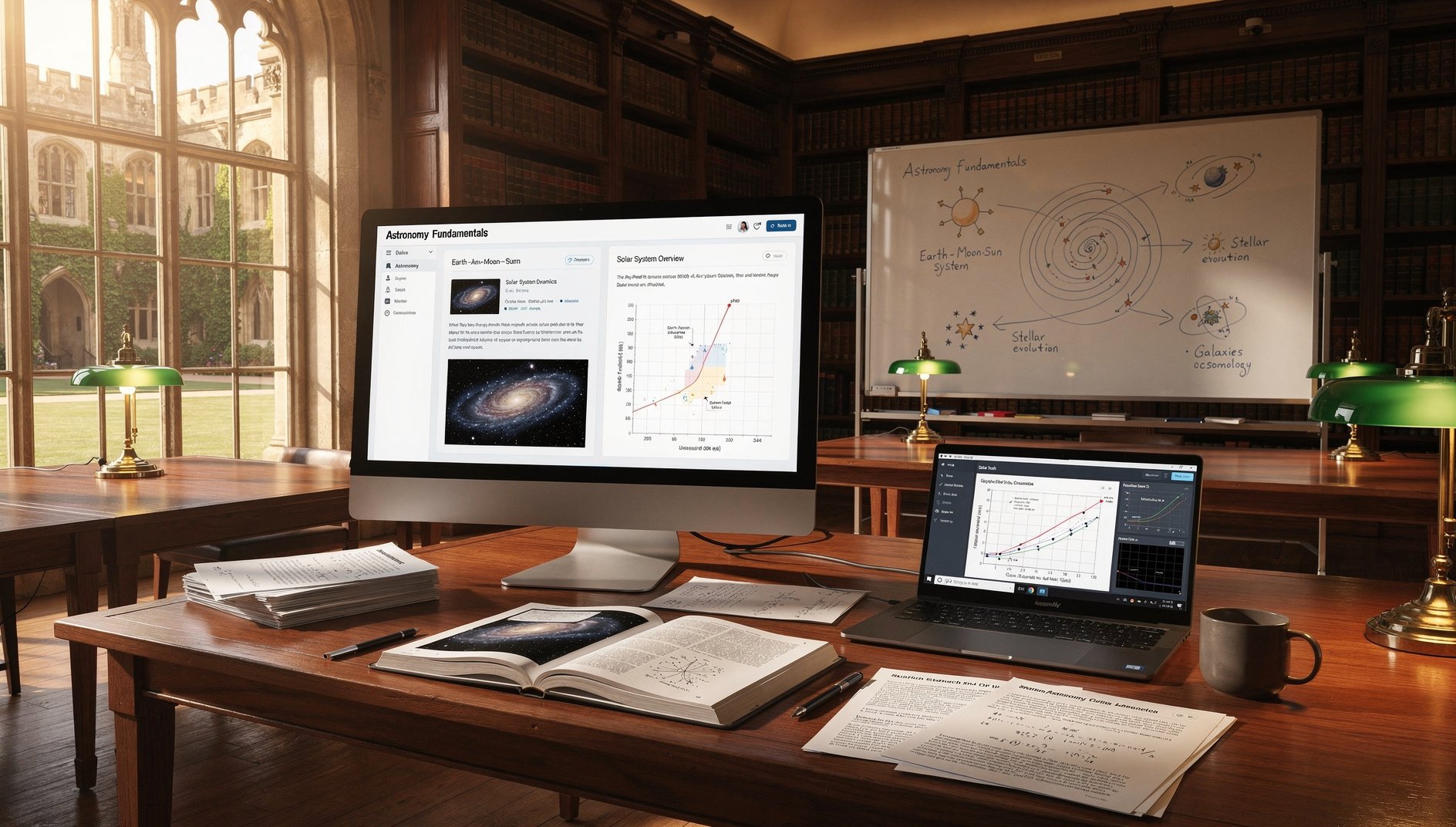
Astronomy Fundamentals
Astronomy Fundamentals covers the full sweep of modern astronomy from Earth-Moon-Sun dynamics and the solar system through stellar evolution, galaxies, cosmology, and the search for life beyond Earth. The course builds physical intuition for vast scales of space and time while grounding concepts in observational evidence and physical principles.
Who Should Take This
This course is ideal for students in introductory astronomy surveys, earth science sequences, or any learner who wants a scientifically rigorous overview of the universe without requiring calculus. It is also well-suited for anyone inspired by space science who wants to understand the underlying physics and evidence behind modern astronomical discoveries.
What's Included in AccelaStudy® AI
Course Outline
1Celestial Sphere and Observational Astronomy 7 topics
Describe the celestial sphere model including the celestial equator, ecliptic, north and south celestial poles, zenith, horizon, and meridian, and explain how it serves as a coordinate reference frame for locating objects
Describe the equatorial coordinate system using right ascension and declination as the celestial analogs of longitude and latitude, and explain how precession of the equinoxes slowly shifts these coordinates over time
Explain the types of optical telescopes (refractors and reflectors) and major telescope parameters including aperture, focal length, resolving power, and light-gathering ability, and describe why large aperture improves resolution
Describe the electromagnetic windows in Earth's atmosphere (optical, radio, infrared, X-ray) and explain why different types of observatories (ground-based, airborne, and space-based) are needed to cover the full spectrum
Apply the concept of angular size and angular separation in arcseconds, arcminutes, and degrees to estimate the apparent diameter of celestial objects and the resolving power requirements for distinguishing them
Analyze how atmospheric seeing, light pollution, and the diffraction limit each impose independent constraints on telescope performance and evaluate which factor dominates in different observing scenarios
Describe the magnitude scale for stellar brightness including apparent magnitude, absolute magnitude, and the distance modulus, and apply the inverse square law to calculate how apparent brightness changes with distance
2Earth-Moon-Sun System 6 topics
Explain the cause of Earth's seasons in terms of axial tilt (23.5 degrees), orbital position, and the resulting variation in solar altitude and day length, and distinguish why the equinoxes and solstices mark seasonal transitions
Describe the eight phases of the Moon in order (new, waxing crescent, first quarter, waxing gibbous, full, waning gibbous, third quarter, waning crescent) and explain why we see different illuminated fractions as the Moon orbits Earth
Explain the geometry of solar and lunar eclipses including the roles of the umbra and penumbra, why eclipses do not occur every month, and the difference between total, partial, and annular solar eclipses
Explain the origin of ocean tides through differential gravitational attraction by the Moon and Sun, including spring and neap tidal cycles, tidal locking, and how tidal friction is gradually slowing Earth's rotation
Describe the distinction between solar time, sidereal time, and standard time zones, and explain why the solar day is approximately 4 minutes longer than the sidereal day due to Earth's orbital motion
Analyze how the relative distances, sizes, and masses of the Earth, Moon, and Sun produce the coincidental near-equality of apparent angular sizes that enables total solar eclipses, and evaluate how this relationship will change as the Moon recedes
3Solar System 8 topics
Describe the formation of the solar system from a collapsing solar nebula including gravitational collapse, disk formation, planetesimal accretion, and differentiation of rocky versus gas giant planets at different distances from the Sun
Identify the eight planets in order from the Sun and distinguish the key physical properties of terrestrial planets (Mercury, Venus, Earth, Mars) from gas giants (Jupiter, Saturn) and ice giants (Uranus, Neptune)
Describe the Sun's structure including the core, radiation zone, convection zone, photosphere, chromosphere, and corona, and explain the proton-proton chain of nuclear fusion that powers the Sun
Apply Kepler's three laws (law of orbits, law of areas, law of periods) to describe planetary orbital shapes, areal sweep rates, and the mathematical relationship between orbital period and semi-major axis
Describe the small body populations of the solar system including the asteroid belt, Kuiper Belt, Oort Cloud, comets (nuclei, coma, and tails), and dwarf planets such as Pluto and Eris
Compare Venus, Earth, and Mars as case studies in divergent planetary evolution, explaining how differences in distance from the Sun, volcanic activity, and atmosphere led to runaway greenhouse effect, habitable conditions, and extreme cold and dryness respectively
Analyze how the impact hypothesis for the Moon's formation (giant impact by a Mars-sized body) is supported by evidence including the Moon's iron-poor composition, similar oxygen isotope ratios to Earth, and the lack of volatiles
Describe the features and activity of the Sun including sunspots, solar flares, coronal mass ejections, and the 11-year solar cycle, and explain how solar activity affects Earth's magnetosphere, auroras, and satellite operations
4Stellar Properties and Life Cycles 8 topics
Describe the properties used to characterize stars including luminosity, temperature, radius, mass, color, and spectral class (O, B, A, F, G, K, M) and explain the relationship between temperature and spectral color
Explain stellar parallax as the most direct method of measuring stellar distances, define the parsec and light-year, and describe why parallax is limited to stars within a few thousand light-years
Interpret the Hertzsprung-Russell (HR) diagram by identifying the main sequence, red giant branch, horizontal branch, white dwarf region, and supergiant stars, and describe the physical properties that place stars in each region
Describe the life cycle of a low-mass star (like our Sun) from nebular collapse through main sequence, red giant, planetary nebula, and white dwarf stages, identifying the nuclear reactions and mass-loss processes at each phase
Describe the life cycle of a high-mass star including the main sequence, red supergiant phase, core collapse supernova, and the formation of either a neutron star or black hole depending on the progenitor's mass
Apply the Stefan-Boltzmann law and Wien's displacement law to calculate or estimate stellar luminosities, temperatures, and radii from observed colors and apparent brightnesses
Explain how stellar spectra reveal composition, temperature, radial velocity, rotation rate, and luminosity class, and describe how spectroscopic binary stars allow measurement of stellar masses through orbital dynamics
Analyze how the mass of a star determines its main sequence lifetime, its evolutionary path on the HR diagram, and its ultimate fate, and evaluate the relationship between stellar mass, nuclear burning rate, and lifetime
5Compact Objects and Extreme Phenomena 5 topics
Describe neutron stars including their formation in core-collapse supernovae, characteristic mass and radius, extreme density, strong magnetic fields, and observable manifestations as pulsars
Describe black holes including the Schwarzschild radius, event horizon, singularity, and the concept that no information can escape from within the event horizon, distinguishing stellar-mass from supermassive black holes
Explain how black holes are detected indirectly through X-ray binary systems, gravitational lensing, stellar orbits near galactic centers, and gravitational wave detection from mergers, and apply the concept that direct imaging requires resolving the shadow
Analyze the role of supermassive black holes at the centers of galaxies as the engines of active galactic nuclei and quasars, and evaluate how feedback from these objects regulates star formation in their host galaxies
Describe gravitational waves including their production by merging compact objects, the general relativistic origin as ripples in spacetime, and how LIGO and Virgo detect them through laser interferometry with arm length changes smaller than a proton
6Galaxies and Galactic Structure 7 topics
Describe the structure of the Milky Way galaxy including the disk, central bulge, stellar halo, globular clusters, spiral arms, and the location of the Sun approximately 26,000 light-years from the galactic center
Classify galaxies using the Hubble tuning fork diagram into elliptical (E0-E7), spiral (Sa-Sc and SBa-SBc), and irregular types, and describe the stellar populations and gas content characteristic of each class
Apply the concept of standard candles including Cepheid variables and Type Ia supernovae to explain how astronomers measure distances to other galaxies beyond the reach of parallax
Explain the evidence for dark matter in galaxies including flat rotation curves, gravitational lensing observations, and cluster dynamics, and describe why dark matter cannot be ordinary baryonic matter
Describe the large-scale structure of the universe including galaxy clusters, superclusters, voids, filaments, and the cosmic web, and explain how gravitational dynamics shape this structure over billions of years
Analyze how galaxy merger simulations reproduce observed tidal tails, ring galaxies, and elliptical galaxy formation, and evaluate the role of mergers in the evolution of galaxy morphology over cosmic time
Explain how the Milky Way's spiral structure is maintained through density waves, describe the major spiral arms and the Local Group of galaxies, and identify the Andromeda galaxy as the Milky Way's closest large neighbor and eventual merger partner
7Cosmology and the Big Bang 8 topics
Describe Hubble's law including the linear relationship between galaxy recession velocity and distance, the Hubble constant, and the implication that the universe is expanding and was once in a more compact hot state
Explain the cosmological redshift as a stretch of photon wavelengths due to the expansion of space rather than a Doppler shift, and apply the redshift formula to relate observed wavelengths to the distance and lookback time of distant galaxies
Describe the evidence supporting the Big Bang model including the cosmic microwave background radiation, the observed abundance of light elements (hydrogen and helium), and the large-scale structure of the universe
Describe the chronology of the early universe from the Planck epoch through quark-gluon plasma, nucleosynthesis of hydrogen and helium, recombination, and the epoch of reionization when the first stars and galaxies formed
Explain cosmic inflation as a proposed period of exponential expansion in the first fraction of a second after the Big Bang, and describe how it accounts for the flatness, horizon, and magnetic monopole problems of standard Big Bang cosmology
Describe dark energy and the accelerating expansion of the universe including the Type Ia supernova evidence, the cosmological constant, and the current estimate that the universe is approximately 68 percent dark energy, 27 percent dark matter, and 5 percent baryonic matter
Analyze how the interplay of dark matter, dark energy, and baryonic matter determines the geometry, expansion history, and ultimate fate of the universe, evaluating the evidence that distinguishes a flat universe from open or closed geometries
Apply Hubble's law to calculate the recession velocity of a galaxy given its redshift and to estimate the age of the universe as approximately the reciprocal of the Hubble constant (approximately 13.8 billion years)
8Exoplanets and the Search for Life 6 topics
Describe the radial velocity (Doppler) method for detecting exoplanets including how the wobble of a star reveals the presence of an orbiting companion, and explain what parameters (period, mass limit, orbital shape) can be derived
Explain the transit method for detecting exoplanets including the light curve dip, transit depth, duration, and how transit observations reveal the planet's radius, orbital period, and atmospheric composition through transmission spectroscopy
Describe the habitable zone concept including the distance range from a star where liquid water could exist on a planet's surface, and explain how stellar luminosity, atmospheric composition, and planetary albedo modify the boundaries
Identify the major exoplanet categories (hot Jupiters, super-Earths, mini-Neptunes, Earth analogues) and compare how orbital dynamics, formation location, and migration history produce the diverse population of exoplanets observed by Kepler and TESS
Analyze the biosignature gases that could indicate life on an exoplanet (oxygen, ozone, methane, nitrous oxide) and evaluate why the simultaneous detection of oxygen and methane would be a strong indicator of biological activity
Describe the direct imaging method for detecting exoplanets including the challenge of the contrast ratio between star and planet, coronagraph technology, and the types of planets most amenable to direct imaging (wide-orbit, young, and massive)
9Cosmic Scales and Distances 5 topics
Describe the cosmic distance ladder including the sequential methods used at increasing distances: parallax, main-sequence fitting, Cepheid variables, Type Ia supernovae, and Hubble's law, and identify the range over which each method is valid
Apply order-of-magnitude estimates to compare the distances and scales from Earth-Moon (384,000 km) through the solar system (40 AU), to the nearest star (4 light-years), the Milky Way (100,000 light-years), and the observable universe (93 billion light-years)
Explain the concept of lookback time and the observable universe, including why the light we receive from distant objects shows us their past state and how the finite age of the universe creates an observational horizon
Analyze how the finite speed of light means that astronomy is inherently the study of the past, and evaluate the implications for interpreting observations of quasars, the cosmic microwave background, and the epoch of reionization as views of the early universe
Describe stellar nucleosynthesis including the fusion of hydrogen to helium on the main sequence, helium burning to carbon and oxygen in giant stars, and the production of elements heavier than iron in supernova explosions and neutron star mergers
Scope
Included Topics
- Celestial sphere, coordinate systems, and sky navigation, Earth-Moon-Sun system including seasons and time zones, lunar phases, solar and lunar eclipses, tidal forces, solar system formation and structure including planets, dwarf planets, moons, asteroids, comets, and Kuiper Belt, stellar properties, spectra, and classification, stellar life cycles and the Hertzsprung-Russell diagram, galaxies and galactic structure, cosmology and the Big Bang, observational astronomy and telescope types, exoplanets and detection methods, black holes and neutron stars, cosmic scales and distances
Not Covered
- Advanced mathematical derivations of orbital mechanics beyond Kepler's laws
- Radio astronomy instrumentation and signal processing detail
- Planetary geology and surface chemistry beyond conceptual comparison
- Astrochemistry and interstellar medium chemistry beyond conceptual nucleosynthesis
- Space mission operations and spacecraft engineering
Ready to master Astronomy Fundamentals?
Adaptive learning that maps your knowledge and closes your gaps.
Enroll