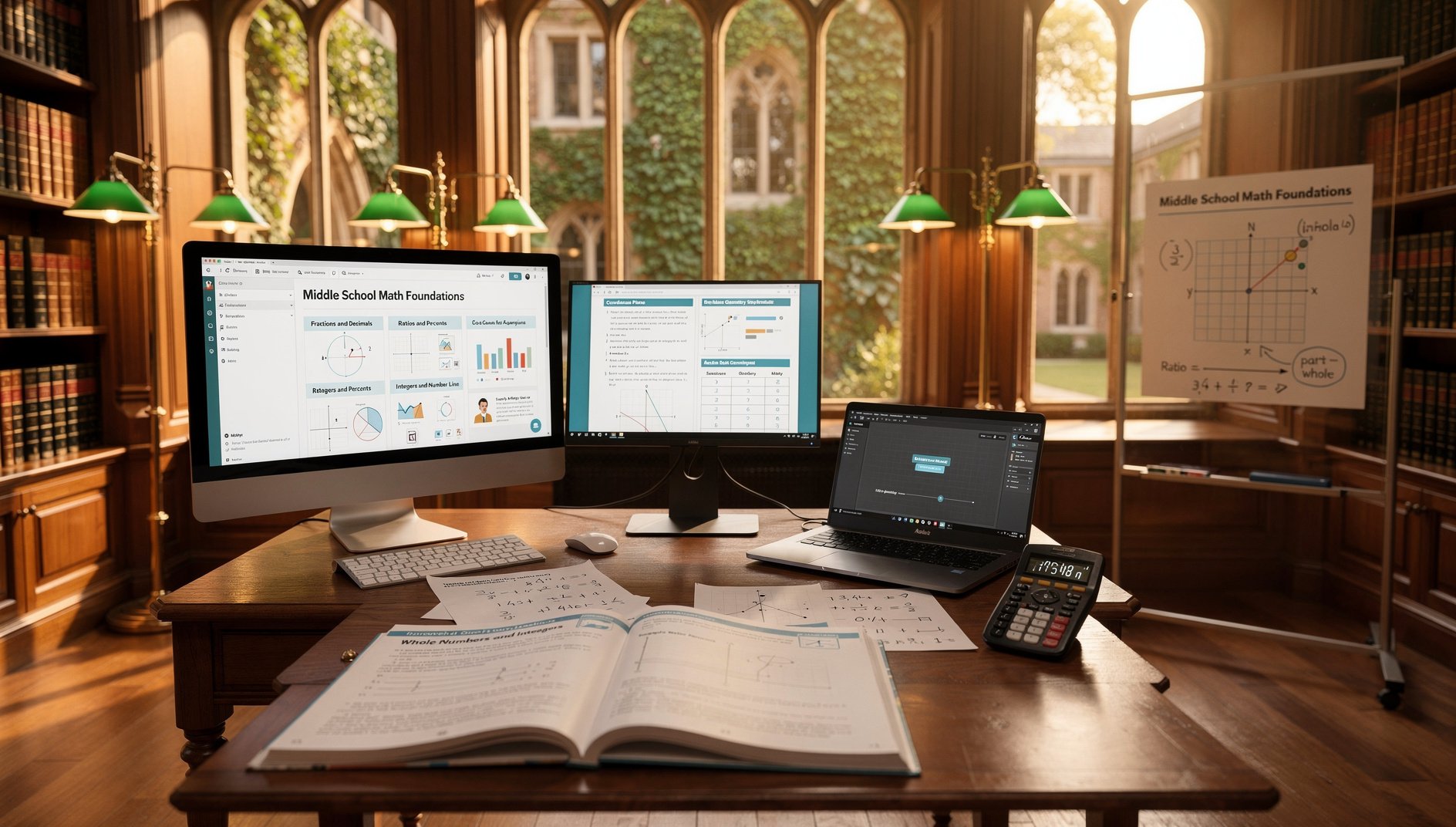
Middle School Math Foundations
Middle School Math Foundations covers the core numeracy concepts students need in grades 6-7: whole numbers, integers, fractions, decimals, ratios, percents, basic geometry, coordinate plane, measurement, and introductory data and probability.
Who Should Take This
Ideal for students in grades 6-7 who are building a solid arithmetic foundation and preparing for Pre-Algebra, as well as adult learners who want to close gaps in foundational number sense, fraction fluency, and proportional reasoning before attempting algebra courses.
What's Covered
1Number Sense and Integer Operations
2Fractions and Decimals
3Ratios, Proportions, and Percents
4Basic Geometry Concepts
5Coordinate Plane
6Data Interpretation and Probability
7Measurement and Unit Conversions
8Problem Solving and Mathematical Reasoning
What's Included in AccelaStudy® AI
Adaptive Knowledge Graph
Practice Questions
Lesson Modules
Console Simulator Labs
Exam Tips & Strategy
13 Activity Formats
Course Outline
1Number Sense and Integer Operations 8 topics
Describe place value for whole numbers and decimals to the millionths and explain how each digit's position determines its value using powers of ten
Apply the four arithmetic operations to multi-digit whole numbers and explain the standard algorithms including carrying, borrowing, and long division with remainders
Describe integers and the number line, identify absolute value as distance from zero, and explain the rules for adding, subtracting, multiplying, and dividing positive and negative integers
Apply integer operations in multi-step problems involving temperature changes, elevation, financial transactions, and other real-world contexts requiring both positive and negative values
Analyze divisibility rules for 2, 3, 4, 5, 6, 9, and 10, apply prime factorization using factor trees, and compute greatest common factor and least common multiple for pairs of whole numbers
Apply order of operations (PEMDAS) to simplify numerical expressions with parentheses, exponents, multiplication, division, addition, and subtraction in the correct sequence
Apply the commutative, associative, and distributive properties to rewrite arithmetic expressions in equivalent forms and justify computational shortcuts like mental multiplication using distributive expansion
Describe negative exponents as reciprocals (x⁻ⁿ = 1/xⁿ), evaluate expressions with zero exponents (x⁰ = 1 for x ≠ 0), and explain why these definitions are consistent with the pattern of dividing by the base
2Fractions and Decimals 7 topics
Describe fractions as division, identify equivalent fractions by multiplying or dividing numerator and denominator by the same nonzero number, and simplify fractions to lowest terms using GCF
Apply addition and subtraction of fractions with unlike denominators by finding the LCD, converting to equivalent fractions, and simplifying results including mixed number conversions
Apply multiplication of fractions by multiplying numerators and denominators, and division of fractions by multiplying by the reciprocal, including mixed number computations in real-world contexts
Apply decimal addition, subtraction, multiplication, and division by aligning place values correctly and explain how multiplying or dividing by powers of ten shifts the decimal point
Convert between fractions, decimals, and percents by dividing numerator by denominator, moving decimal places, or setting up proportions, and order these representations on a number line
Analyze which representation (fraction, decimal, percent) is most efficient for a given context such as financial calculations, measurements, or comparisons, and justify the choice
Apply estimation of fraction and decimal computations by rounding operands to the nearest benchmark (0, 1/2, 1) before computing to quickly judge whether exact answers are reasonable
3Ratios, Proportions, and Percents 8 topics
Describe a ratio as a comparison of two quantities by division, express ratios in three forms (a:b, a to b, a/b), and identify equivalent ratios by scaling up or down
Apply unit rate calculations by dividing the first quantity by the second and use unit rates to solve comparison shopping, speed, and density problems in real-world contexts
Apply cross-multiplication to solve proportions with one unknown value and verify solutions by checking that both ratios are equivalent after substitution
Apply percent formulas to calculate part, whole, and percent including percent of a number, percent increase and decrease, simple interest, tax, tip, and discount in consumer contexts
Analyze proportional relationships in tables, graphs, and equations to identify the constant of proportionality and determine whether a relationship is proportional or non-proportional
Apply scale factors to interpret maps and scale drawings by setting up proportions and computing actual distances or dimensions from given scale ratios
Apply multi-step percent problem solving including finding the original price given a discounted price and the discount percentage, and computing compound percent changes by applying successive multipliers
Describe the concept of tax rate and calculate sales tax, income tax at a flat rate, and explain how a 15% tax differs from a 20% tip as applications of the same percent-of-a-whole calculation
4Basic Geometry Concepts 9 topics
Describe geometric terms including point, line, line segment, ray, angle, parallel lines, perpendicular lines, and transversal, and classify angles as acute, right, obtuse, or straight by their degree measure
Apply the angle relationships formed by parallel lines cut by a transversal including corresponding, alternate interior, alternate exterior, and co-interior angles to find missing angle measures
Classify triangles by side length (scalene, isosceles, equilateral) and angle measure (acute, right, obtuse), and apply the triangle angle sum theorem that interior angles sum to 180 degrees
Apply perimeter formulas for triangles, rectangles, squares, parallelograms, trapezoids, and regular polygons, and compute circumference of circles using C = 2πr and C = πd
Apply area formulas for rectangles, triangles, parallelograms, trapezoids, and circles including composite figures formed by combining or subtracting standard shapes
Apply volume formulas for rectangular prisms, triangular prisms, cylinders, and pyramids, and calculate surface area by summing the areas of all faces of a 3D figure
Analyze the effect of scaling a figure by a factor k on perimeter (multiplied by k), area (multiplied by k²), and volume (multiplied by k³) and apply this understanding to real-world enlargement problems
Describe properties of quadrilaterals (parallelogram, rectangle, rhombus, square, trapezoid) by their angle and side relationships, and use these properties to solve for unknown angle measures and side lengths
Apply the relationship between radius, diameter, and circumference of circles to solve problems involving arc length and the fraction of a circle's circumference represented by a given central angle
5Coordinate Plane 6 topics
Describe the coordinate plane including the x-axis, y-axis, origin, and four quadrants, and identify the sign conventions for ordered pairs (x, y) in each quadrant
Apply coordinate plotting by accurately placing ordered pairs on a coordinate grid and identifying the coordinates of given points in all four quadrants including points on the axes
Apply the distance formula for vertical and horizontal line segments on the coordinate plane by computing the absolute difference of like coordinates and use this to find perimeter of polygons
Apply reflections of points and figures across the x-axis, y-axis, and the origin by negating the appropriate coordinates and describe how reflections preserve shape and size
Analyze tables of (x, y) values to determine whether a proportional or linear relationship exists, plot the points, and connect them to form a line while interpreting slope as unit rate
Apply the midpoint of a line segment by averaging the x-coordinates and averaging the y-coordinates of the two endpoints, and use this to find the center of a segment in design and navigation problems
6Data Interpretation and Probability 9 topics
Describe measures of central tendency including mean (arithmetic average), median (middle value), and mode (most frequent value), and explain when each measure best represents a data set
Apply calculations of mean, median, mode, and range to data sets and identify how adding an outlier changes each measure, explaining why mean is most sensitive to extreme values
Apply data reading skills to interpret bar graphs, line graphs, pictographs, pie charts, histograms, and stem-and-leaf plots by answering questions about frequency, comparison, and change over time
Describe theoretical probability as the ratio of favorable outcomes to total equally likely outcomes, express it as a fraction, decimal, or percent, and identify the probability of impossible and certain events
Apply experimental probability by conducting or analyzing trials, computing relative frequency of outcomes, and comparing experimental results to theoretical predictions with increasing sample sizes
Apply the counting principle and organized lists or tree diagrams to enumerate sample spaces for two-stage experiments and calculate probabilities of compound independent events
Analyze misleading graphs and statistics by identifying distortions from manipulated scales, cherry-picked data, inappropriate chart types, and explain how to present data more accurately and fairly
Apply frequency table construction from raw data sets, create histograms with equal-width intervals, and interpret the distribution's shape, identifying clusters, gaps, and outliers in the display
Analyze the appropriateness of data collection methods by distinguishing surveys (self-reported data), experiments (controlled conditions), and observations (recorded without intervention), and explain how each can introduce different types of error
7Measurement and Unit Conversions 6 topics
Describe the US customary and metric measurement systems including base units for length, mass, volume, and time, and the prefix multipliers (milli-, centi-, kilo-) in the metric system
Apply dimensional analysis (unit factor method) to convert within the US customary system and within the metric system by multiplying by conversion fractions equal to one
Apply estimation strategies for length, area, volume, and mass using benchmark measurements such as a centimeter approximating a fingernail width and a kilogram approximating a textbook
Apply significant figures and rounding rules to measurements, explain the difference between precision and accuracy, and identify the appropriate level of precision for given measurement instruments
Analyze unit consistency in multi-step measurement problems by converting all quantities to common units before computing, and evaluate whether a computed answer has a reasonable magnitude
Apply time conversions and elapsed time calculations across hours, minutes, and seconds including clock arithmetic problems, schedule problems, and computing duration between AM and PM times
8Problem Solving and Mathematical Reasoning 7 topics
Describe strategies for solving word problems including identifying given information, defining what is unknown, choosing an operation, computing, and checking that the answer is reasonable
Apply multi-step problem solving by breaking complex problems into simpler sub-problems, computing each sub-problem in sequence, and combining intermediate results to reach a final answer
Apply estimation and mental math techniques including front-end estimation, compatible numbers, and rounding to quickly assess whether computed answers are in a reasonable range
Analyze patterns in numerical sequences, geometric figures, and tables to identify the underlying rule, extend the pattern, and explain whether the rule always holds using examples and counterexamples
Apply guess-and-check, draw-a-diagram, make-a-table, and work-backward strategies to solve non-routine problems and explain why each strategy is appropriate for specific problem structures
Analyze whether a given mathematical claim or solution is valid by checking for computational errors, unit errors, incorrect formula application, and explaining specifically where any error occurs and what the correct solution is
Apply number sense to consumer math problems including budgeting, comparing unit prices, computing sales tax and tip, and interpreting pay stubs with hourly rates and overtime, connecting math to everyday financial decisions
Scope
Included Topics
- Whole numbers and place value, integer operations (addition, subtraction, multiplication, division), fractions (equivalent fractions, simplifying, adding/subtracting/multiplying/dividing), decimals, ratios and proportions, percent concepts and applications, order of operations (PEMDAS), basic geometry (lines, angles, polygons, circles), perimeter, area, surface area, volume of basic 3D shapes, coordinate plane (quadrant I and all four quadrants), plotting and interpreting ordered pairs, data interpretation (tables, bar graphs, line graphs, pie charts), measures of central tendency, basic probability (experimental and theoretical)
Not Covered
- Algebraic equations and variables (covered in Pre-Algebra)
- Advanced geometry with algebraic proofs (covered in Geometry)
- Statistical inference and hypothesis testing (covered in Statistics)
- Trigonometry or coordinate geometry beyond simple plotting
- Calculator-dependent computations — emphasis is on conceptual understanding and mental math fluency
Ready to master Middle School Math Foundations?
Adaptive learning that maps your knowledge and closes your gaps.
Enroll