Film Studies
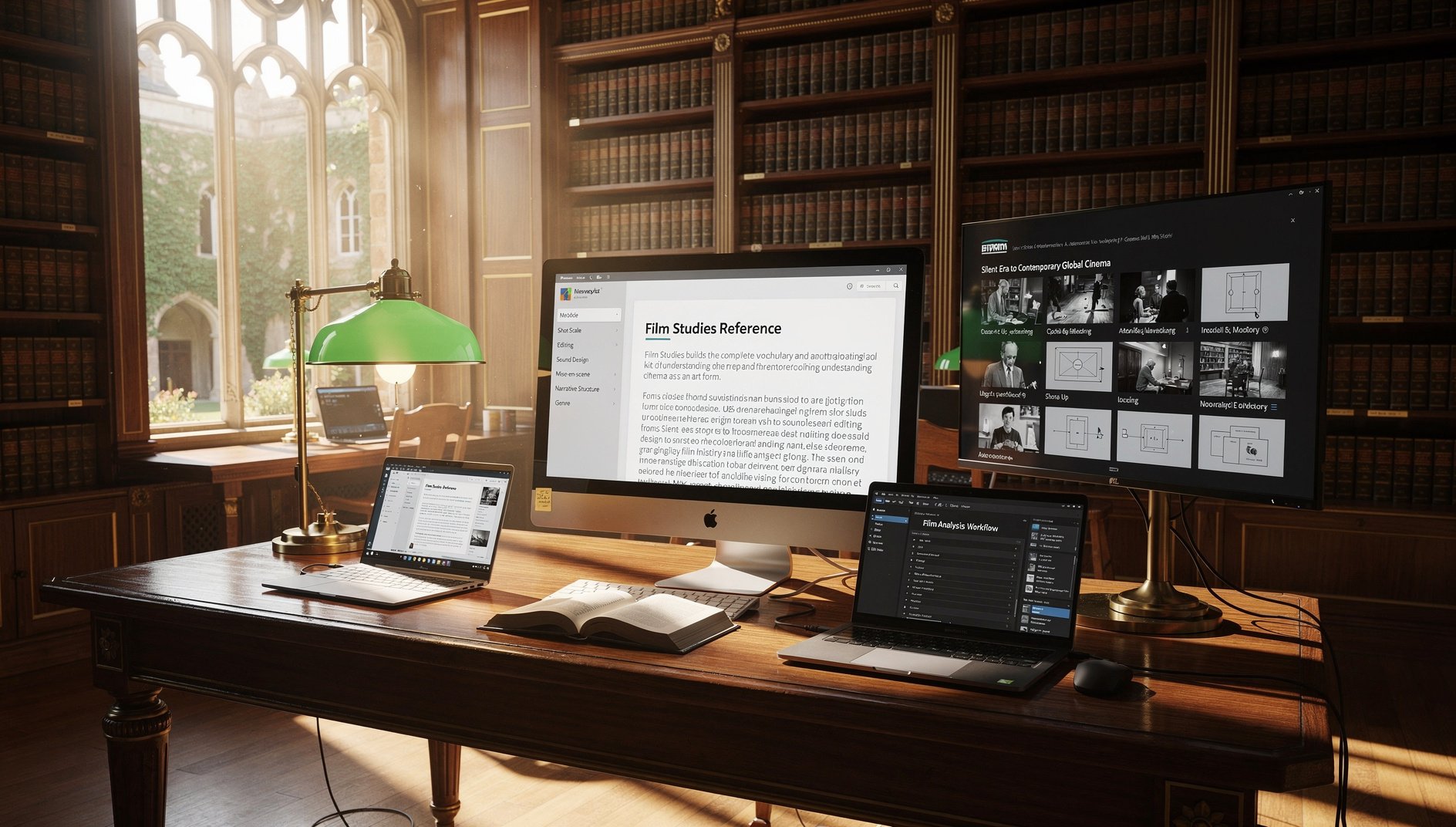
Film Studies builds the complete vocabulary and analytical toolkit for understanding cinema as an art form — from shot scale and editing to sound design, mise-en-scène, narrative structure, and genre — surveying film history from the silent era through contemporary global cinema.
Who Should Take This
Ideal for high school students in grades 9-12 taking a film studies or media literacy course and for any film enthusiast who wants to move from casual viewing to rigorous analytical engagement with cinema. No prior film studies knowledge is required.
What's Covered
1Cinematography: Shots, Angles, and Framing
2Editing and Montage
3Sound Design and Music
4Mise-en-Scène and Visual Design
5Narrative Structure and Genre
6Film History and Major Movements
7Film Criticism, Documentary, and Animation
8Cross-Film Analysis and Thematic Study
What's Included in AccelaStudy® AI
Adaptive Knowledge Graph
Practice Questions
Lesson Modules
Console Simulator Labs
Exam Tips & Strategy
13 Activity Formats
Course Outline
1Cinematography: Shots, Angles, and Framing 8 topics
Identify the standard shot scales from extreme wide shot through extreme close-up and describe the emotional and narrative function of each scale — extreme wide establishing context and isolation, close-up revealing interiority and emphasis
Identify camera angles including high angle (diminishes subject), low angle (empowers subject), eye-level (neutral), Dutch/canted angle (unease or psychological disturbance) and explain the affective meaning each angle conventionally communicates
Apply framing analysis by identifying the rule of thirds, leading room, headroom, and foreground-background relationships in a still frame and explaining how the director's framing choice shapes viewer attention and emotional tone
Identify camera movement types — pan (horizontal rotation), tilt (vertical rotation), dolly/track (physical movement toward or away), crane (vertical movement through space), handheld (unstable, documentary feel), Steadicam (fluid, floating) — and their expressive associations
Apply deep focus and shallow depth of field analysis by explaining how Orson Welles's deep focus in Citizen Kane foregrounds compositional complexity and multiple planes of action simultaneously, contrasting with shallow focus that isolates a single subject from its environment
Analyze how a director's systematic cinematographic choices — a preference for long takes and wide angles versus rapid close-ups, handheld versus Steadicam — constitute a visual style that reflects the film's thematic concerns and emotional register
Apply analysis of the zoom lens versus the dolly move as fundamentally different ways to change apparent focal length — the zoom compresses space and feels mechanical or surveillance-like, the dolly preserves spatial relationships and feels physically present — and cite specific films that use each for expressive effect
Identify the long take as a virtuosic cinematographic choice — Hitchcock's Rope as a false continuous take, Cuarón's single-take action sequences in Children of Men — and explain how uncut duration creates realism, tension, and viewer identification through the illusion of unmediated presence
2Editing and Montage 8 topics
Identify the principles of continuity editing including the 180-degree rule (keeping camera on same side of the action axis), shot-reverse-shot for dialogue, match cut (cutting on similar movement or form), and eyeline match (connecting a look to its object)
Apply analysis of how continuity editing constructs invisible narrative space by maintaining spatial and temporal coherence and creating the illusion of seamless story world — and explain why violations of its rules are felt as jolts by the viewer
Identify Eisenstein's Soviet montage theory including the collision principle — cutting together images that create a third meaning through their juxtaposition — and apply it to his Battleship Potemkin to explain how editing constructs political and emotional argument rather than narrative space
Apply analysis of the jump cut as used by Godard in Breathless — deliberately breaking continuity by cutting within a single shot to create temporal ellipsis, stylistic self-consciousness, and restlessness — contrasting its effect with a classical match cut
Apply L-cut and J-cut analysis by explaining how these audio-visual bridges — where sound begins before or after the image cut — smooth transitions, build tension, or create ironic counterpoint between sound and image
Analyze how editing pace and rhythm — the length of individual shots, the pattern of cuts — shapes the viewer's physiological and emotional response in action sequences (rapid cutting, sensory overwhelm) versus contemplative scenes (long takes, patience, weight)
Apply analysis of parallel editing (cross-cutting) — cutting between two simultaneous actions in different locations — and explain how Griffith developed this technique in The Birth of a Nation and Intolerance as a way to build tension, imply causal connection, and control narrative timing
Identify the concept of pace in editing as the film's felt tempo — the average shot length (ASL), the relationship between cutting rhythm and music rhythm, and how editors like Walter Murch use the 'rule of six' to prioritize emotion, story, and rhythm over mere spatial continuity
3Sound Design and Music 6 topics
Identify diegetic sound (originating from within the story world — dialogue, ambient noise, music the characters hear) and non-diegetic sound (originating outside the story world — the film score, voice-over narration) and explain how each creates a different relationship between viewer and story world
Apply analysis of Foley sound design by explaining how every footstep, creak, and texture heard in a film is artificially created in post-production and how precise Foley work constructs sensory presence and realism in a fictional world
Apply analysis of the leitmotif technique in film scores — identifying how Bernard Herrmann uses a recurring string motif to encode threat in Psycho or how John Williams associates characters with recurring themes in Star Wars — and explain how musical repetition shapes narrative memory
Analyze how silence functions as an active expressive choice in films like A Quiet Place and Tarkovsky's Stalker — the deliberate absence of expected sound as a source of tension, dread, spiritual weight, or the uncanny
Apply analysis of contrapuntal sound — when the soundtrack deliberately clashes with or comments ironically on the image — as in Kubrick's use of cheerful pop music during ultraviolence in A Clockwork Orange, and explain how the mismatch forces the viewer into an uncomfortable critical distance
Describe the transition from silent film to sound (The Jazz Singer, 1927) including the technical and aesthetic challenges of synchronization, the temporary regression in cinematographic freedom as cameras were locked in soundproof booths, and the eventual liberation of sound as a new expressive dimension
4Mise-en-Scène and Visual Design 6 topics
Identify the components of mise-en-scène including production design (sets, locations), costume and makeup, props, actor blocking and performance register, and color palette as the total visual environment that the camera captures
Apply analysis of color as a thematic and emotional tool in film by examining how Wes Anderson's symmetrical pastel palettes construct ironic nostalgia, how Schindler's List's red coat uses color contrast for moral emphasis, or how Parasite's architecture encodes class hierarchy
Apply analysis of lighting in film including the emotional register of high-key (bright, even, comedic or romantic), low-key (shadowed, noir, threatening), and chiaroscuro (dramatic light-dark contrast for moral complexity or dread)
Analyze how mise-en-scène and cinematography function as two distinct but interacting layers of visual meaning — the director chooses what is in the frame (mise-en-scène) and then how to frame it (cinematography) — using a single scene as a case study
Apply analysis of actor performance style in film — the difference between theatrical, presentational performance and the Stanislavski-derived method acting's psychological realism — and explain how the camera's proximity makes subtlety of expression in film performance a different skill set than stage acting
Identify the concept of production design as world-building and apply it to analyze how Tim Burton's expressionist architecture, the period-accurate sets of Kubrick's The Shining, or the color-coded spaces of Parasite's vertical house create environments that are themselves characters expressing the film's themes
5Narrative Structure and Genre 7 topics
Identify the three-act structure in classical narrative cinema including setup, confrontation, and resolution, and explain how structural variations — non-linear narrative, fragmented chronology, circular endings — create different emotional and interpretive effects
Apply the distinction between story (the chronological chain of events) and plot (the order in which those events are presented to the viewer) and analyze how films like Memento, Arrival, or Pulp Fiction use plot reordering to create suspense, surprise, or thematic meaning
Identify the defining conventions of major film genres including Western (frontier myth, moral landscape, good vs. evil), film noir (femme fatale, moral ambiguity, chiaroscuro), horror (abjection, the uncanny, violation of bodily integrity), and romantic comedy (meet-cute, obstacles, reconciliation) with representative examples
Apply genre analysis by identifying where a film uses, subverts, or deconstructs genre conventions — explaining why a film like Get Out is both horror and social satire, and what the genre hybridization achieves that a pure genre film could not
Analyze how the unreliable narrator — as in The Usual Suspects, Gone Girl, or Fight Club — uses viewer identification with an untrustworthy perspective to interrogate the nature of narrative authority, memory, and the conventions of cinematic truth
Apply analysis of the setup and payoff structure in narrative film — the Chekhov's gun principle, the plant and reveal technique — and explain how skilled screenwriting and editing creates the retrospective inevitability of events that seemed arbitrary on first viewing
Identify the concept of film noir as both a visual style and a narrative mode — the femme fatale, the doomed protagonist, the corrupt city, the flashback confessional structure — and explain how classic noir (Double Indemnity, Chinatown) and neo-noir (Drive, Blade Runner) use darkness and moral ambiguity as a.
6Film History and Major Movements 10 topics
Identify the silent film era including Méliès's fantasy spectacle (A Trip to the Moon), Griffith's narrative editing innovations in Birth of a Nation and the ethical controversies it raises, and Keaton's physical comedy as pure cinema
Describe classical Hollywood cinema including the studio system (major and minor studios, genre factory production), the star system, production code censorship, and the narrative and technical innovations of Hitchcock, Welles, and Wilder
Apply analysis of Italian neorealism including Rossellini's Rome Open City and De Sica's Bicycle Thieves examining location shooting, non-professional actors, social subject matter (poverty, occupation), and the ethical and political implications of neorealist aesthetics
Apply analysis of the French New Wave including Godard's Breathless and Truffaut's The 400 Blows examining the rejection of classical Hollywood grammar, the auteur theory of the director as film's primary author, jump cuts, handheld camera, and explicit reference to the history of cinema
Describe New Hollywood cinema of the 1970s including Kubrick, Coppola, Scorsese, Spielberg, and Altman and explain how this generation used European art cinema techniques (ambiguity, moral complexity, formal risk) within Hollywood genre frameworks
Describe contemporary global cinema including the Hong Kong action film (Woo, Wong Kar-wai), Iranian cinema (Kiarostami), and South Korean genre cinema (Bong Joon-ho's Parasite) and explain how each tradition uses Hollywood conventions while expressing distinctly non-Western cultural perspectives
Analyze how each major film movement — neorealism, French New Wave, New Hollywood, global cinema — was shaped by its specific historical and cultural context and represented a reaction against both the dominant Hollywood model and the political or social conditions of its moment
Apply analysis of Akira Kurosawa's Rashomon examining the multiple-perspective narrative structure where the same violent event is retold four times by conflicting witnesses, and explain how the film raises epistemological questions about truth, memory, and self-interest that influenced hundreds of later films
Describe the Hollywood blockbuster era from Jaws and Star Wars onward — the replacement of auteur cinema by high-concept franchise filmmaking, the impact of home video and then streaming on theatrical culture, and the resulting tension between cinema as art and cinema as industrial entertainment
Describe Latin American cinema as a global film movement including Brazilian Cinema Novo (Glauber Rocha's aesthetic of hunger), the Third Cinema manifesto of Solanas and Getino calling for film as a tool of political liberation, and the Cuban ICAIC's state-supported art cinema as distinct approaches to filmmaking outside Hollywood commercial.
7Film Criticism, Documentary, and Animation 9 topics
Identify the auteur theory — the French New Wave critics' claim that certain directors impose a personal vision across multiple films through recurring themes, stylistic signatures, and obsessive motifs — and explain both its utility and limitations as a critical framework
Apply auteur analysis to a specific director — Kubrick, Hitchcock, Kurosawa, or Bong Joon-ho — by identifying the recurring formal, thematic, and iconographic signatures that make their films immediately recognizable and coherent as a body of work
Identify the four major documentary modes as classified by Bill Nichols — expository (voice-of-God narration, Attenborough nature documentary), observational (fly-on-the-wall, Wiseman), participatory (filmmaker present, Moore), and performative (subjective, lyric essay film) — with examples of each
Apply analysis of a documentary's mode and rhetorical strategy — how it positions the viewer toward its subject, what it includes and excludes, how it uses music and narration — and evaluate the ethical responsibilities of documentary filmmakers toward their subjects
Describe the history and evolution of animation including traditional cel animation (Disney Golden Age), stop-motion (Harryhausen, Laika), and digital CGI (Pixar), and explain how each technique shapes the visual texture and storytelling possibilities of the animated film
Apply a complete scene analysis by integrating all five analytical categories — cinematography, editing, sound, mise-en-scène, and narrative function — to explain how a single two-minute sequence produces its emotional and thematic effect through the coordinated deployment of cinematic language
Analyze how cinema as a medium is uniquely capable of combining image, sound, performance, editing, and time to produce forms of meaning and emotional experience that cannot be achieved by any single art form — and evaluate the claim that film is the defining art form of the 20th century
Apply analysis of observational documentary ethics in cinéma vérité films like Frederick Wiseman's Titicut Follies or the Maysles Brothers' Grey Gardens — examining whether the camera's presence alters the reality it claims to record and what obligations filmmakers have toward their subjects
Identify the key features of the essay film — an experimental non-fiction form used by Chris Marker, Agnes Varda, and Werner Herzog — that blends first-person narration, archival footage, philosophical reflection, and personal memory to create a subjective document that resists both narrative and documentary conventions
8Cross-Film Analysis and Thematic Study 6 topics
Apply comparison of how two films in the same genre — two Westerns, two horror films, two romantic comedies — use and subvert genre conventions differently to reveal different cultural anxieties, values, or historical moments
Analyze how cinema has historically represented race, gender, and class — from Hollywood's classic stereotypes to contemporary contestations — and evaluate how the demographics of who makes films shapes whose stories are told and how
Apply analysis of the horror film's recurring cultural anxieties — the monster as the return of the repressed, the slasher's punishment of transgressive sexuality, zombie films as capitalism critique — and explain how genre conventions become vehicles for social commentary precisely because their coded nature lowers audiences' defenses
Identify the concept of cinematic adaptation — the translation of literary texts into film — and apply analysis of one major adaptation (a Shakespeare play, a Victorian novel, a graphic novel as film) examining what the adaptation gains from the cinematic medium and what necessarily changes in translation
Apply analysis of how a single film integrates all its formal systems — cinematography, editing, sound, mise-en-scène, narrative, and genre — to argue for an interpretation of the film's central meaning, using specific scenes as evidence for a coherent interpretive argument
Analyze how science fiction cinema — from Metropolis through 2001: A Space Odyssey to Arrival — uses speculative futures and alien others to displace anxieties about contemporary technology, social control, and the definition of the human onto a safely imaginary register
Scope
Included Topics
- Elements of cinematography (shots — extreme wide, wide, medium, close-up, extreme close-up; angles — high, low, Dutch; framing — rule of thirds, leading room, headroom; camera movement — pan, tilt, dolly, crane, handheld, Steadicam; focus — deep focus, shallow depth of field, rack focus), editing (continuity editing — 180-degree rule, shot-reverse-shot, match cut, eyeline match; non-continuity editing — jump cut, L-cut, J-cut; montage theory — Soviet montage, Eisenstein's collision principle), sound design (diegetic vs. non-diegetic sound, sound bridge, Foley, leitmotif, silence as expressive tool), lighting (three-point lighting, high-key vs. low-key, chiaroscuro, natural light), mise-en-scène (production design, costume, props, actor blocking, color palette as expressive tool), narrative structure (three-act structure, non-linear narrative, unreliable narrator, story vs. plot), genre conventions (Western, noir, horror, romantic comedy, action, science fiction — genre markers and subversions), film history (silent era — Méliès, Griffith, Keaton; classical Hollywood — studio system, Hitchcock, Welles; Italian neorealism — Rossellini, De Sica; French New Wave — Godard, Truffaut; New Hollywood — Kubrick, Coppola, Scorsese, Spielberg; contemporary global cinema — Hong Kong action, Iranian cinema, South Korean thriller), major directors and their signatures, documentary filmmaking modes (expository, observational, participatory, performative), animation basics (traditional cel, stop-motion, digital CGI)
Not Covered
- Screenwriting as a standalone craft course
- Film production and cinematography technique beyond conceptual understanding
- Advanced auteur theory as a scholarly critical framework
- Film business, distribution, and marketing
- Video game design and interactive narrative
Ready to master Film Studies?
Adaptive learning that maps your knowledge and closes your gaps.
Enroll