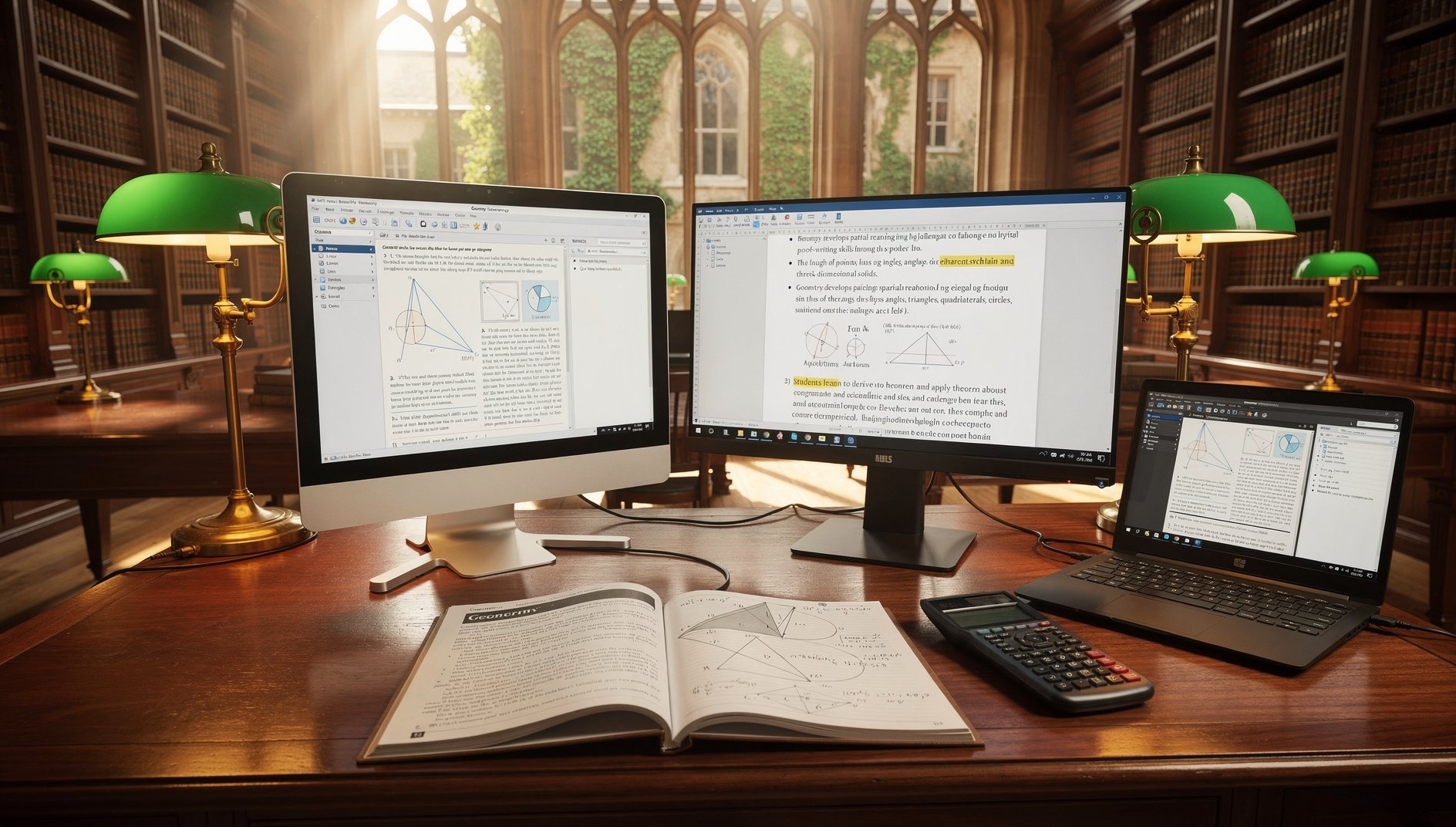
Geometry
Geometry develops spatial reasoning and logical proof-writing skills through the study of points, lines, angles, triangles, quadrilaterals, circles, and three-dimensional solids. Students learn to derive and apply theorems about congruence and similarity, calculate measurements of planar and solid figures, and use coordinate methods to verify geometric relationships.
Who Should Take This
This course is designed for high-school students who have completed Algebra I and are ready to develop formal deductive reasoning alongside spatial visualization. It is also appropriate for anyone who wants to sharpen geometric intuition, practice proof-writing, or prepare for standardized tests that include geometry questions.
What's Covered
1Foundations of Geometry
2Angle Relationships and Parallel Lines
3Triangles: Congruence and Properties
4Similarity and Right-Triangle Trigonometry
5Quadrilaterals
6Circles
7Area, Perimeter, Surface Area, and Volume
8Transformations
9Coordinate Geometry and Proofs
What's Included in AccelaStudy® AI
Adaptive Knowledge Graph
Practice Questions
Lesson Modules
Console Simulator Labs
Exam Tips & Strategy
13 Activity Formats
Course Outline
1Foundations of Geometry 6 topics
Identify and name fundamental geometric figures including points, lines, rays, segments, planes, and explain how three non-collinear points determine a unique plane
Calculate segment lengths using the segment addition postulate and apply the midpoint formula to find the midpoint or an endpoint of a segment given the other endpoint
Apply the distance formula derived from the Pythagorean theorem to compute the length of a segment on the coordinate plane given the coordinates of its endpoints
Name and classify angle types (acute, right, obtuse, straight, reflex) and apply the angle addition postulate to find unknown angle measures in a figure
Identify complementary, supplementary, vertical, adjacent, and linear-pair angle relationships and calculate unknown angle measures using these relationships
Analyze the logical structure of a geometric proof including undefined terms, definitions, postulates, and theorems and explain the difference between inductive and deductive reasoning in geometry
2Angle Relationships and Parallel Lines 6 topics
Identify angle pairs formed when a transversal intersects two lines including corresponding, alternate interior, alternate exterior, co-interior (same-side interior), and co-exterior angles
Apply the parallel lines cut by a transversal theorems to calculate unknown angle measures and determine when two lines are parallel based on given angle relationships
Prove lines are parallel or perpendicular using angle relationship theorems (converse of corresponding angles, alternate interior angles) in a formal two-column proof
Apply the properties of perpendicular lines and the perpendicular bisector theorem to find equidistant points and construct perpendicular bisectors using geometric reasoning
Analyze real-world and diagram-based multi-step angle problems involving parallel lines, transversals, and polygons by chaining multiple theorems together in a logical sequence
Apply the angle bisector definition and the angle bisector theorem to find unknown angle measures and segment lengths in diagrams involving bisected angles and proportional sides
3Triangles: Congruence and Properties 7 topics
State the triangle congruence postulates and theorems (SSS, SAS, ASA, AAS, HL) and identify corresponding parts of congruent triangles from a congruence statement
Prove two triangles congruent using SSS, SAS, ASA, AAS, or HL in a two-column proof and use CPCTC to establish congruence of corresponding parts as a consequence
Apply the triangle angle-sum theorem (180 degrees) and exterior angle theorem to find missing angle measures, and classify triangles by side lengths (scalene, isosceles, equilateral) and angles
Apply properties of isosceles and equilateral triangles including the isosceles triangle theorem (base angles congruent) and its converse to find missing measures and write proofs
Identify and apply properties of triangle midsegments, medians, altitudes, perpendicular bisectors, and angle bisectors including the triangle midsegment theorem and concurrency points
Analyze the triangle inequality theorem to determine whether three given side lengths can form a triangle and apply the hinge theorem to compare sides or angles of two triangles
Evaluate a multi-step congruence proof involving multiple pairs of triangles, auxiliary lines, or properties derived from parallel lines, justifying each statement with an appropriate reason
4Similarity and Right-Triangle Trigonometry 7 topics
State the triangle similarity criteria (AA, SAS similarity, SSS similarity) and identify similar triangles by verifying congruent angles and proportional sides
Apply the properties of similar triangles to set up and solve proportions for unknown side lengths and angle measures in geometric diagrams and real-world indirect measurement problems
Apply the Pythagorean theorem and its converse to solve for missing side lengths in right triangles and classify triangles as acute, right, or obtuse based on side length relationships
Apply the 45-45-90 and 30-60-90 special right triangle ratios to find exact side lengths without a calculator, recognizing the patterns from their derivations
Calculate sine, cosine, and tangent ratios for acute angles in a right triangle and use these ratios to find missing side lengths or angle measures in right-triangle application problems
Solve real-world problems involving angles of elevation and depression by drawing a right triangle diagram, identifying the relevant trig ratio, and computing the unknown distance or angle
Prove triangles similar using AA or SAS similarity and use the triangle proportionality theorem (parallel line divides sides proportionally) in a formal geometric proof
5Quadrilaterals 7 topics
List the properties of parallelograms including opposite sides parallel and congruent, opposite angles congruent, consecutive angles supplementary, and diagonals bisecting each other
Apply properties of rectangles, rhombuses, and squares to find missing angle measures, diagonal lengths, and side lengths, distinguishing which properties are unique to each special parallelogram
Apply the properties of trapezoids (one pair of parallel sides) and isosceles trapezoids (congruent legs, congruent base angles, congruent diagonals) to solve for unknown measures
Calculate the interior angle sum of any polygon using the formula (n minus 2) times 180 degrees and apply the exterior angle sum theorem (360 degrees for convex polygons)
Prove that a quadrilateral is a specific type (parallelogram, rectangle, rhombus, square) using coordinate geometry by computing slopes, distances, and midpoints of the diagonals
Analyze which minimal set of properties is sufficient to classify a quadrilateral as a particular special type and evaluate common misconceptions about the hierarchy of quadrilateral classification
Apply the midsegment theorem for trapezoids (midsegment parallel to bases and equal to half their sum) to find unknown segment lengths and verify the theorem using coordinate geometry
6Circles 7 topics
Identify parts of a circle including center, radius, diameter, chord, secant, tangent, arc (minor, major, semicircle), central angle, and inscribed angle and state their definitional relationships
Apply the central angle theorem (central angle equals intercepted arc measure) and inscribed angle theorem (inscribed angle equals half intercepted arc) to find unknown arc and angle measures
Apply theorems about chords, tangents, and secants including the chord-chord angle theorem, tangent-tangent angle, and power of a point to calculate segment lengths and arc measures
Calculate arc length and sector area using the proportional relationship between the central angle, arc length, and the circumference or total area of the circle
Write and interpret the standard-form equation of a circle (x minus h) squared plus (y minus k) squared equals r squared given its center and radius on the coordinate plane
Prove properties of inscribed angles including that angles inscribed in a semicircle are 90 degrees and that opposite angles of a cyclic quadrilateral are supplementary
Analyze multi-step circle problems that combine arc measure, chord length, tangent segment, and angle theorems to find all unknowns in a complex circle diagram
7Area, Perimeter, Surface Area, and Volume 7 topics
State the perimeter and area formulas for triangles, parallelograms, trapezoids, rhombuses, regular polygons, and circles and apply them to compute measures in composite figures
Calculate the area of a composite figure by decomposing it into non-overlapping basic shapes, computing each area separately, and summing or subtracting as appropriate
Calculate lateral surface area and total surface area of prisms, pyramids, cylinders, cones, and spheres using the appropriate net-based or formula-based method
Calculate the volume of prisms, pyramids, cylinders, cones, and spheres using Cavalieri's principle and standard formulas, including composite 3D solids
Analyze how scale factors affect perimeter, area, and volume of similar figures using the ratios k, k squared, and k cubed respectively, and apply this to real-world scaling problems
Solve optimization problems involving maximizing area given a fixed perimeter or minimizing surface area for a given volume by comparing configurations and reasoning geometrically
Calculate the density of a figure using the ratio of its area or volume to the given population or mass, applying area and volume formulas as intermediate steps in multi-part modeling problems
8Transformations 6 topics
Describe the four rigid transformations (translation, reflection, rotation, and glide reflection) and explain how each preserves distance and angle measure, making pre-image and image congruent
Apply translations, reflections over coordinate axes and lines y equals x or y equals negative x, and rotations of 90, 180, and 270 degrees to plot image coordinates on the coordinate plane
Apply dilations with a given scale factor and center of dilation to find image coordinates and calculate how dilation affects side lengths, angle measures, perimeter, and area
Identify the single transformation or composition of transformations that maps a pre-image onto a given image, writing the rule in coordinate notation
Analyze line symmetry and rotational symmetry of regular polygons and other figures by identifying all lines of symmetry and the angles of rotational symmetry
Evaluate how transformations relate to congruence and similarity by explaining why rigid motions preserve congruence and dilations produce similarity rather than congruence
9Coordinate Geometry and Proofs 7 topics
Apply slope relationships to determine if lines are parallel (equal slopes), perpendicular (negative reciprocal slopes), or neither, and write equations of related lines
Solve geometric problems on the coordinate plane using distance, midpoint, and slope formulas together, such as classifying triangles and quadrilaterals by their vertices
Write and interpret two-column proofs using definitions, postulates, and theorems as justifications, constructing a logically valid chain from given information to the desired conclusion
Write coordinate geometry proofs by placing figures on the coordinate plane using general variables, computing slopes and distances, and drawing geometric conclusions from algebraic results
Analyze the completeness and validity of a geometric proof by identifying missing steps, unjustified claims, or logical gaps and revising the argument to correct the errors
Evaluate whether a coordinate or synthetic proof approach is more efficient for a given geometric theorem and explain the trade-offs between generality and computational effort
Prove the Pythagorean theorem using coordinate geometry or a dissection proof and explain how its converse can be used to determine whether three lengths form a right triangle
Scope
Included Topics
- Points, lines, planes, and segments (definitions, naming, measurement, midpoint, distance formula), angle types and relationships (complementary, supplementary, vertical, linear pairs, transversals with parallel lines), triangles (congruence criteria SSS/SAS/ASA/AAS/HL, similarity criteria AA/SAS/SSS, Pythagorean theorem, right triangle trigonometric ratios), quadrilaterals (parallelograms, rectangles, rhombuses, squares, trapezoids, kites and their properties), circles (central and inscribed angles, arcs, chords, tangents, secants, arc length, sector area), area and perimeter of 2D figures, surface area and volume of 3D solids, transformations (translations, reflections, rotations, dilations and their effects on congruence/similarity), coordinate geometry (slope, distance, midpoint, equations of lines and circles), geometric proofs (two-column, paragraph, flow)
Not Covered
- Analytic geometry beyond conic sections in standard form
- Three-dimensional coordinate geometry beyond introductory concepts
- Calculus-based area computations
- Non-Euclidean geometry