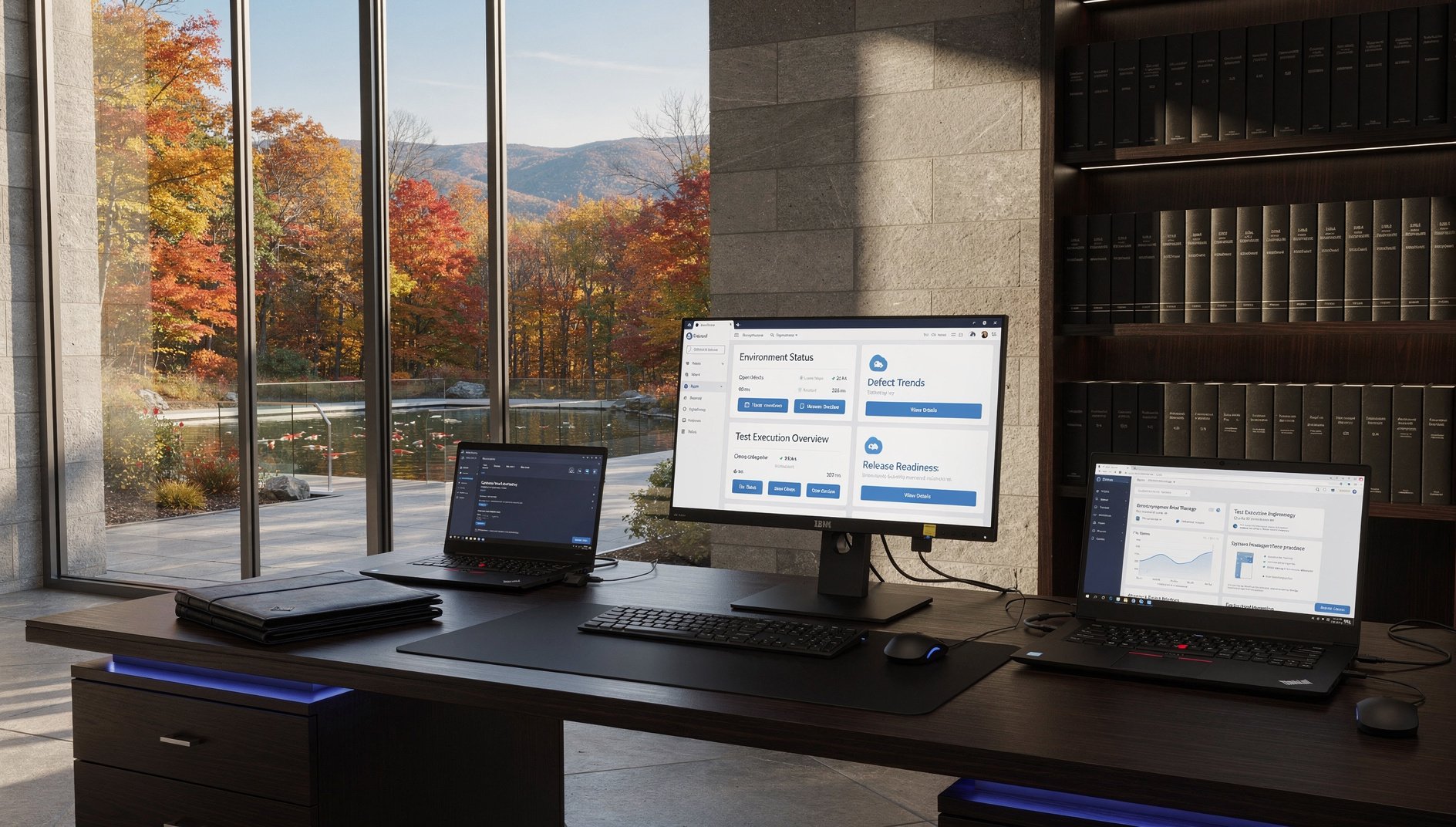
This course is in active development. Preview the scope below and create a free account to be notified the moment it goes live.
Engineering Test Management
The course teaches engineers how to design, configure, and manage IBM Engineering Test Management v7.x, covering architecture, test planning, execution, defect integration, and reporting to ensure effective quality assurance.
Who Should Take This
It is intended for test managers, quality engineers, and senior developers who have at least two years of experience with IBM ELM tools and seek to lead test management initiatives. These professionals aim to deepen their strategic and analytical skills to optimize test processes and align defect management with enterprise reporting standards.
What's Covered
1Domain 1: ETM Architecture and Configuration
2Domain 2: Test Planning
3Domain 3: Test Execution
4Domain 4: Defect Management Integration
5Domain 5: Reporting and Metrics
6Domain 6: Administration and Best Practices
What's Included in AccelaStudy® AI
Course Outline
1Domain 1: ETM Architecture and Configuration 3 topics
Platform Setup
- Implement Engineering Test Management installation on Jazz Team Server with database and license configuration.
- Configure project area creation with test process templates, team areas, and iteration definitions.
- Analyze deployment topology to design single-server and distributed Jazz configurations for testing teams.
- Design enterprise test management architecture with federated servers and cross-project sharing.
Data Model Configuration
- Implement custom test artifact types with attributes, categories, and enumeration values.
- Configure test plan and test case templates with standardized structures and default attributes.
- Analyze testing data model requirements to design artifact hierarchies for complex product testing.
Integration Setup
- Implement OSLC integration with DOORS Next for requirements-to-test traceability links.
- Configure integration with RTC for defect linking and build-triggered test execution.
- Analyze cross-tool integration requirements to design end-to-end lifecycle traceability connecting requirements management and test execution.
2Domain 2: Test Planning 3 topics
Test Plan Creation
- Implement test plans with objectives, scope definitions, entry and exit criteria, and resource assignments.
- Configure test plan hierarchies with master plans, child plans, and iteration-specific planning.
- Analyze test planning metrics to evaluate plan completeness and coverage against requirements.
- Design test planning strategies for iterative development with regression and progressive elaboration.
Test Case Development
- Implement test cases with preconditions, execution steps, expected results, and post-conditions.
- Configure parameterized test cases with test data sets for data-driven testing approaches.
- Analyze test case quality using review workflows and coverage analysis against requirements.
Test Suite Organization
- Implement test suites with test case grouping, execution ordering, and schedule assignment.
- Configure test suite hierarchy with functional areas, priority levels, and execution type classification.
- Analyze test suite composition to optimize execution time and maximize coverage per test cycle.
3Domain 3: Test Execution 3 topics
Manual Test Execution
- Implement manual test execution workflows with step-by-step recording, verdict assignment, and evidence attachment.
- Configure execution records with environment details, build identifiers, and execution context.
- Analyze test execution results to identify test failures requiring investigation and retest.
Automated Test Integration
- Implement automated test adapter configuration for JUnit, Selenium, and custom automation frameworks.
- Configure continuous integration triggers for automated test execution on build completion.
- Analyze automated test results to correlate failures with code changes and identify flaky tests.
- Design test automation strategies balancing automated regression coverage with manual exploratory testing.
Lab Management
- Implement test environment definitions with hardware, software, and network configuration specifications.
- Configure lab resource reservation and scheduling for test execution across shared environments.
- Analyze lab utilization patterns to optimize environment provisioning and reduce wait times.
4Domain 4: Defect Management Integration 3 topics
Defect Reporting
- Implement defect submission from test execution results with automatic population of failure context.
- Configure defect-to-test traceability with bidirectional links for retest tracking and verification workflow management.
- Analyze defect patterns to identify systemic quality issues requiring root cause investigation.
Defect Workflow
- Implement defect triage workflows with severity classification, assignment routing, and priority management.
- Configure defect state transitions with approval gates, verification steps, and closure criteria.
- Analyze defect lifecycle metrics to evaluate fix quality and identify teams needing process improvement.
- Design defect management strategies integrating testing, development, and release management workflows.
Retest Management
- Implement retest procedures with defect verification, regression check, and confirmation execution.
- Configure retest tracking with test execution result linking to resolved defect records.
- Analyze retest effectiveness to evaluate fix completeness and identify recurring defect patterns.
5Domain 5: Reporting and Metrics 3 topics
Test Progress Reporting
- Implement test execution progress dashboards with planned vs actual execution and pass/fail metrics.
- Configure trend reports for test execution velocity, defect discovery rate, and coverage progress.
- Analyze test progress metrics to forecast completion dates and identify at-risk test objectives.
Quality Metrics
- Implement quality indicator dashboards with defect density, test effectiveness, and requirements coverage.
- Configure custom metrics definitions with calculated fields and threshold-based status indicators.
- Analyze quality trends across releases to evaluate product maturity and release readiness.
- Design quality metrics programs with automated collection, benchmarking, and management reporting.
Document Generation
- Implement test report generation using RPE templates for formal test summary documentation.
- Configure automated report distribution with scheduled generation and email delivery.
- Analyze reporting requirements to design document templates meeting regulatory evidence standards.
6Domain 6: Administration and Best Practices 3 topics
System Administration
- Implement user management with role assignments, license allocation, and project access provisioning.
- Configure server administration with backup procedures, storage management, and performance monitoring.
- Analyze server utilization to plan capacity upgrades and optimize resource allocation.
Process Customization
- Implement process template customization with workflow modifications, custom attributes, and UI configuration.
- Configure operational behavior settings with required fields, state transitions, and validation rules.
- Analyze process adherence metrics to identify non-compliance and recommend process improvements.
- Design test process improvement programs using metrics-driven analysis and team retrospective feedback.
Migration and Integration
- Implement test asset migration from legacy tools using ETM import utilities and API-based data transfer.
- Configure cross-project test asset sharing with component reuse and linked lifecycle configurations.
- Analyze migration completeness to validate test asset fidelity and traceability preservation.
Scope
Included Topics
- All domains of IBM Engineering Test Management (S2000-017).
- ETM v7.x: test planning, execution, defect integration, reporting.
- Jazz platform: OSLC integration, global configuration, stream management.
- Test automation integration, lab management, and metrics.
Not Covered
- Engineering Workflow Management (RTC) administration.
- Non-IBM test management tools (TestRail, Zephyr, qTest).
- Test automation framework development beyond ETM integration.
- Systems engineering modeling beyond test management.
Official Exam Page
Learn more at IBM
S2000-017 is coming soon
Adaptive learning that maps your knowledge and closes your gaps.
Create Free Account to Be Notified