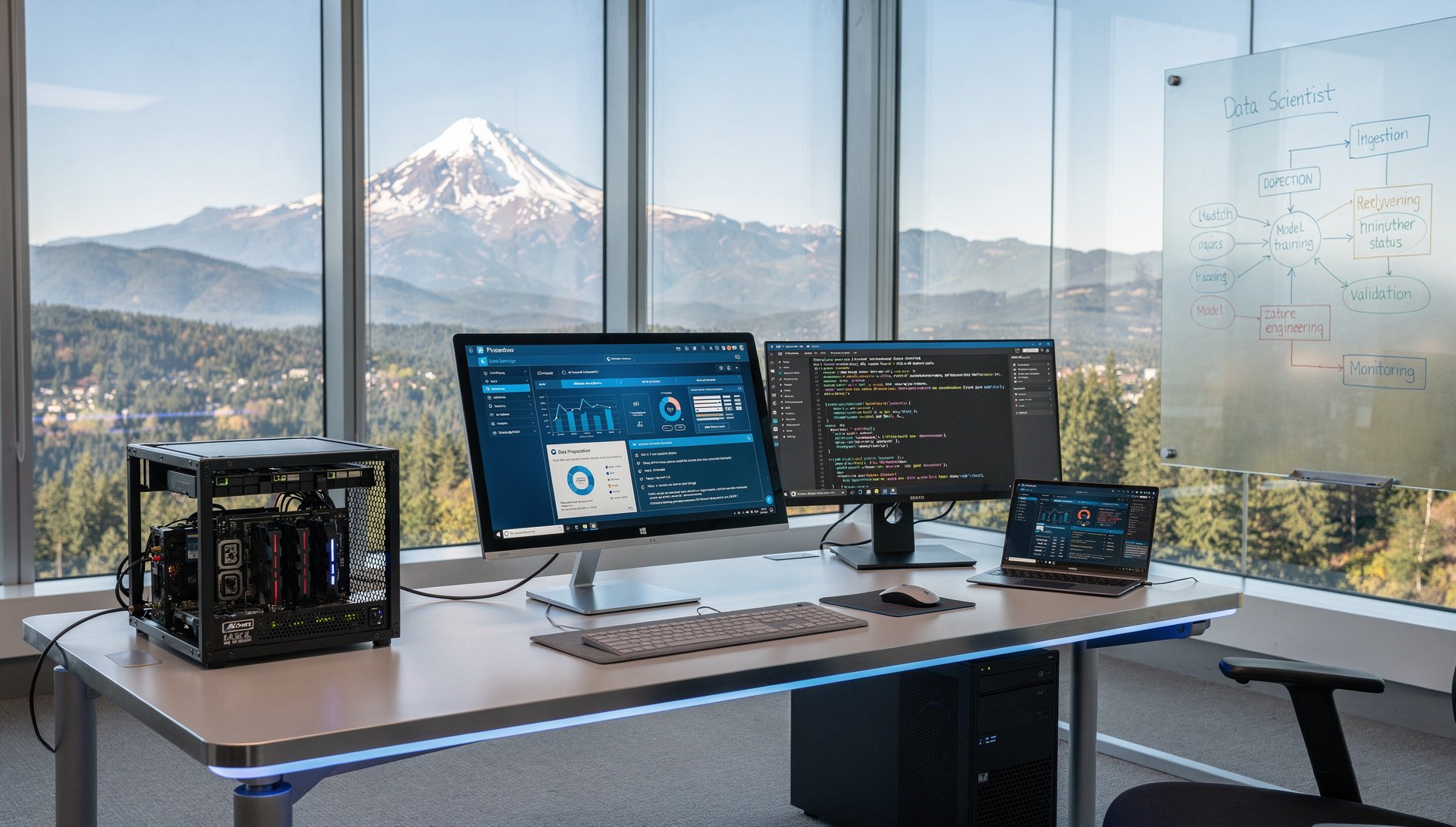
Data Scientist
The course teaches how to design, build, and deploy machine‑learning solutions using Azure Machine Learning, covering data preparation, model training, deployment, and MLOps best practices.
Who Should Take This
It is aimed at data scientists, ML engineers, or analytics professionals who have at least one year of hands‑on experience with Azure and want to validate their ability to operationalize models. Learners seek to earn the Microsoft Azure Data Scientist Associate credential and advance their careers in cloud‑based AI solutions.
What's Covered
1Selecting compute resources, configuring Azure ML workspaces, managing data assets, and designing ML pipelines for training workflows.
2Performing exploratory data analysis, feature engineering, selecting algorithms, training models with automated ML, and evaluating model performance.
3Registering models, packaging models for deployment, implementing responsible AI dashboards, and configuring model explainability.
4Deploying models to managed online endpoints, batch endpoints, implementing model monitoring, and configuring retraining pipelines.
Exam Structure
Question Types
- Multiple Choice
- Multiple Response
- Case Studies
Scoring Method
Scaled score 100-1000, passing score 700
Delivery Method
Proctored exam, 40-60 questions, 100 minutes
Prerequisites
None required. DP-900 recommended.
Recertification
Renew annually via free Microsoft Learn renewal assessment
What's Included in AccelaStudy® AI
Course Outline
1Domain 1: Design and Prepare a Machine Learning Solution 2 topics
Design a machine learning solution
- Identify supervised, unsupervised, and reinforcement learning paradigms and explain when to apply classification, regression, clustering, anomaly detection, and recommendation algorithms for given business objectives.
- Identify model families including linear models, tree-based ensembles, neural networks, and time-series forecasting algorithms and explain the data characteristics and problem constraints that favor each family.
- Identify Azure Machine Learning services including AutoML, Designer, and the Python SDK and explain when each training approach is appropriate based on team skill level, problem complexity, and time constraints.
- Select an appropriate training approach by evaluating tradeoffs among Azure Machine Learning AutoML, Designer drag-and-drop pipelines, and custom script-based training using the Python SDK for a given scenario.
- Configure compute target selection by choosing among compute instances, compute clusters, serverless compute, and attached computes based on training workload requirements for CPU, GPU, memory, and cost.
- Determine data collection and preparation strategies by identifying required features, assessing data availability, planning labeling workflows, and evaluating data volume requirements for a machine learning project.
- Analyze model form factor requirements including real-time latency constraints, batch throughput needs, edge deployment targets, and model size limitations to determine the optimal serving architecture for a given scenario.
Manage an Azure Machine Learning workspace
- Identify Azure Machine Learning workspace components and explain the roles of compute instances, compute clusters, datastores, data assets, environments, and the model registry within the workspace architecture.
- Identify Azure Machine Learning datastore types and explain how Azure Blob Storage, Azure Data Lake Storage Gen2, Azure SQL Database, and Azure Files integrate as registered datastores for ML workflows.
- Create and configure an Azure Machine Learning workspace with appropriate resource group, storage account, key vault, container registry, and networking settings to support team-based data science development workflows.
- Create and register Azure Machine Learning data assets as URI files, URI folders, or MLTable definitions and configure versioning to enable reproducible data references across training experiments.
- Configure Azure Machine Learning compute clusters with appropriate VM sizes, scaling limits, idle timeout policies, and low-priority VM options to balance training performance with cost efficiency.
- Create custom Azure Machine Learning environments from conda specification files, pip requirements files, or Docker build contexts and register them with versioning for reuse across training and deployment jobs.
- Configure role-based access control for Azure Machine Learning workspace resources using Microsoft Entra ID identities, custom roles, and managed identities to enforce least-privilege security for data science teams.
- Analyze workspace topology tradeoffs including single-workspace versus multi-workspace patterns, network isolation with private endpoints, and shared compute strategies for enterprise data science teams.
- Analyze environment management tradeoffs between curated environments for rapid prototyping and custom Docker images for production deployment considering build time, dependency control, and image size optimization.
2Domain 2: Explore Data and Train Models 3 topics
Explore data using Python and Pandas
- Identify exploratory data analysis techniques and explain how summary statistics, distribution visualizations, correlation analysis, and missing value assessments inform feature selection and model design decisions.
- Implement data profiling using Pandas and Azure Machine Learning notebooks to calculate descriptive statistics, detect outliers, visualize feature distributions, and assess data quality in training datasets.
- Implement missing value imputation strategies including mean, median, mode, KNN-based, and iterative imputation methods and configure appropriate handling for training, validation, and inference data pipelines.
- Implement techniques for handling imbalanced datasets including oversampling with SMOTE, undersampling, class weighting, and stratified splitting to improve model performance on minority class predictions.
- Analyze data characteristics including class imbalance severity, multicollinearity, skewed distributions, and temporal dependencies to determine appropriate preprocessing and modeling strategies before training.
Train and evaluate classification and regression models
- Identify feature engineering techniques and explain how normalization, standardization, one-hot encoding, ordinal encoding, binning, and log transformations improve model training signal quality.
- Identify evaluation metrics for classification including accuracy, precision, recall, F1 score, AUC-ROC, and log loss and for regression including MAE, MSE, RMSE, and R-squared and explain when each metric is most informative.
- Implement feature scaling and encoding transformations using scikit-learn pipelines to prepare numerical, categorical, and text features for model consumption within Azure Machine Learning training workflows.
- Train classification and regression models by selecting appropriate scikit-learn estimators, fitting training data, generating predictions, and computing evaluation metrics for model performance assessment.
- Implement cross-validation strategies including k-fold, stratified k-fold, and leave-one-out to assess model generalization performance and reduce overfitting risk on limited training datasets.
- Implement dataset splitting strategies for training, validation, and test sets with stratification, time-based splits, and group-aware splits to prevent data leakage and ensure valid model evaluation.
- Configure regularization techniques including L1, L2, and elastic net penalties and explain how regularization strength parameters control model complexity and mitigate overfitting for linear and tree-based models.
- Configure hyperparameter tuning search spaces, sampling methods, and early termination policies for Azure Machine Learning sweep jobs to optimize model hyperparameters across candidate configurations.
- Analyze model evaluation results including learning curves, confusion matrices, and sweep job outputs to diagnose overfitting, underfitting, and hyperparameter sensitivity and determine corrective training actions.
- Analyze feature engineering tradeoffs affecting model signal quality, data leakage risk, and pipeline maintainability when selecting among encoding strategies, dimensionality reduction, and feature selection methods.
Train and evaluate deep learning models
- Identify deep learning frameworks supported in Azure Machine Learning including PyTorch and TensorFlow and explain when neural network architectures are preferred over traditional ML approaches for image, text, and tabular data.
- Identify transfer learning concepts and explain how pretrained models, feature extraction, and fine-tuning strategies reduce training data requirements and accelerate model development for image and text tasks.
- Train deep learning models using PyTorch or TensorFlow within Azure Machine Learning by configuring training scripts with data loaders, model architectures, loss functions, and optimization algorithms.
- Implement transfer learning workflows by loading pretrained models, freezing base layers, and fine-tuning classification heads on domain-specific datasets using PyTorch or TensorFlow within Azure Machine Learning.
- Configure distributed training across multiple GPU nodes using Azure Machine Learning compute clusters with PyTorch DistributedDataParallel or TensorFlow MirroredStrategy for large-scale deep learning workloads.
- Implement deep learning model evaluation using appropriate metrics including accuracy, loss curves, precision-recall for classification, and perplexity for language models to measure convergence and generalization quality.
- Analyze deep learning training diagnostics including loss plateaus, gradient issues, learning rate schedules, and overfitting indicators to determine corrective actions such as regularization, architecture changes, or data augmentation.
3Domain 3: Prepare a Model for Deployment 3 topics
Run model training scripts in Azure Machine Learning
- Identify Azure Machine Learning training job concepts and explain how command jobs, environment definitions, compute targets, input and output bindings, and experiment tracking enable reproducible model training workflows.
- Configure Azure Machine Learning command jobs specifying compute target, environment, script path, input data bindings, output locations, and experiment name using the Python SDK v2 for remote training execution.
- Configure data inputs for Azure Machine Learning training jobs using URI file, URI folder, and MLTable input modes with download and mount access options for different data volume and performance requirements.
- Implement MLflow experiment tracking to log parameters, metrics, artifacts, and model signatures during training runs for comparison, reproducibility, and downstream model registration workflows.
- Configure and run Azure Machine Learning AutoML experiments specifying task type, primary metric, training data, validation strategy, blocked algorithms, and timeout constraints using the Python SDK.
- Analyze training job outputs including logged metrics, learning curves, AutoML leaderboards, and model artifacts to diagnose training issues and select the best performing model for registration and deployment.
- Analyze data access mode tradeoffs between download and mount options considering dataset size, I/O performance, storage costs, and compute target capabilities to optimize training job data throughput.
Implement training pipelines in Azure Machine Learning
- Identify Azure Machine Learning pipeline concepts and explain how pipeline jobs, components, data flow between steps, and parameterized execution enable reproducible multi-step training workflows.
- Create reusable Azure Machine Learning components with defined inputs, outputs, environment, and command specifications for modular pipeline step composition and cross-team sharing.
- Build and submit Azure Machine Learning pipeline jobs connecting data preparation, training, evaluation, and registration components with defined data dependencies and compute target assignments.
- Configure data passing between pipeline steps using named inputs and outputs, intermediate data assets, and pipeline data flow definitions to chain sequential processing stages within training workflows.
- Configure Azure Machine Learning pipeline job schedules using time-based triggers and event-based triggers to automate periodic model retraining and data-driven pipeline execution workflows.
- Analyze pipeline design patterns and evaluate improvements for component reuse, step caching, failure recovery, data lineage tracking, and execution efficiency in end-to-end model training workflows.
Register and manage models
- Identify Azure Machine Learning model registry concepts and explain how model registration, versioning, tags, properties, and MLflow model logging enable model lifecycle governance and reproducibility.
- Create and register trained models in the Azure Machine Learning model registry from local files, job outputs, or MLflow runs with appropriate versioning, metadata tags, and model format specifications.
- Implement MLflow model packaging with defined model signatures, input examples, and conda or pip dependency specifications to create self-contained deployable model artifacts.
- Analyze model versioning and governance strategies to determine the optimal registry organization for model lineage tracking, approval workflows, and safe promotion across development and production stages.
4Domain 4: Deploy and Retrain a Model 4 topics
Deploy a model to a managed endpoint
- Identify managed online endpoint concepts and explain how endpoints, deployments, traffic allocation, authentication modes, and scaling rules enable real-time model serving in Azure Machine Learning.
- Identify model packaging concepts and explain how scoring scripts, environment definitions, model artifacts, and deployment configurations combine into deployable model packages for Azure Machine Learning endpoints.
- Create scoring scripts with init() and run() functions that load registered models, deserialize input requests, perform inference, and return serialized predictions for managed online endpoint deployment.
- Deploy a registered model to a managed online endpoint by configuring the deployment definition, specifying instance type and count, setting authentication mode, and validating endpoint health with test requests.
- Implement blue-green and A/B deployment strategies using multiple deployments under a single managed online endpoint with traffic splitting rules to enable safe model updates and version comparison testing.
- Analyze managed online endpoint deployment failures and determine corrective actions by examining deployment logs, container health probes, scoring script errors, and resource allocation issues.
Deploy a model to a batch endpoint
- Identify batch endpoint concepts and explain how batch deployments, mini-batch processing, output file configuration, and compute cluster assignments enable large-scale offline inference in Azure Machine Learning.
- Deploy a model to a batch endpoint by configuring the batch deployment with scoring script, environment, compute cluster, mini-batch size, output action, and error threshold settings for offline prediction jobs.
- Invoke batch endpoint jobs with input data references and monitor job progress, output file generation, and error logs to verify successful large-scale batch inference execution.
- Analyze batch endpoint performance and determine optimization strategies for mini-batch size, compute cluster scaling, error handling thresholds, and retry policies to maximize throughput and minimize processing costs.
Apply MLOps practices
- Identify MLOps concepts and explain how model monitoring, automated retraining triggers, model registration automation, and CI/CD integration support production machine learning lifecycle management on Azure.
- Identify Azure Machine Learning monitoring capabilities and explain how data collection, data drift detection, prediction drift detection, and data quality monitoring detect production model degradation over time.
- Configure retraining triggers using Azure Machine Learning pipeline schedules, data drift alerts, and performance threshold violations to automate model refresh workflows when production model quality degrades.
- Configure automated model registration workflows that promote validated models from training pipelines to the model registry with appropriate versioning, metadata, and approval gates for deployment readiness.
- Configure Azure Machine Learning model monitoring with data drift detection, prediction drift detection, and data quality monitoring using baseline datasets, alert thresholds, and notification configurations.
- Configure Azure Monitor alerts and dashboards for endpoint operational metrics including request latency, error rates, CPU and memory utilization, and deployment health status for production model observability.
- Analyze monitoring alerts, drift detection results, and model performance trends to determine whether model retraining, data pipeline remediation, threshold recalibration, or model rollback is the appropriate corrective response.
- Analyze end-to-end MLOps maturity and evaluate the integration of retraining automation, model governance, deployment strategies, and monitoring feedback loops to optimize the production ML lifecycle.
Implement responsible AI practices
- Identify responsible AI principles and explain how fairness, reliability, privacy, inclusiveness, transparency, and accountability apply to machine learning model development and deployment on Azure.
- Create Azure Machine Learning Responsible AI dashboards with error analysis, model interpretability, fairness assessment, and counterfactual analysis components to evaluate model behavior across demographic groups.
- Configure model interpretability using feature importance, SHAP values, and explanation dashboards within Azure Machine Learning to provide transparency into model prediction drivers for stakeholder communication.
- Analyze Responsible AI dashboard outputs to identify fairness disparities, error cohorts, and feature attribution anomalies and determine mitigation strategies including data rebalancing, model constraints, and threshold calibration.
Hands-On Labs
Practice in a simulated cloud console or Python code sandbox — no account needed. Each lab runs entirely in your browser.
Certification Benefits
Salary Impact
Related Job Roles
Industry Recognition
Microsoft Azure certifications are among the most valued in enterprise IT, with Microsoft holding the second-largest cloud market share globally and serving as the dominant platform in enterprise and hybrid cloud environments.
Scope
Included Topics
- All domains and task statements in the Microsoft Azure Data Scientist Associate (DP-100) exam guide: Domain 1 Design and Prepare a Machine Learning Solution (20-25%), Domain 2 Explore Data and Train Models (35-40%), Domain 3 Prepare a Model for Deployment (20-25%), and Domain 4 Deploy and Retrain a Model (10-15%).
- Associate-level data science responsibilities on Azure including ML solution design, workspace management, data exploration, feature engineering, model training and evaluation, deep learning, training pipelines, Automated ML, managed and batch endpoint deployment, MLOps practices, data drift monitoring, and model retraining workflows.
- Key Azure services for data scientists: Azure Machine Learning (Workspace, Studio, Designer, AutoML, Compute Instances, Compute Clusters, Managed Online Endpoints, Batch Endpoints, Pipelines, Components, Environments, Data Assets, Datastores, Model Registry, Responsible AI Dashboard), Azure Databricks, Azure Blob Storage, Azure Data Lake Storage Gen2, Azure Container Registry, Azure Monitor, Azure Key Vault, and Microsoft Entra ID.
- Practical workflow decisions involving model selection, compute optimization, training orchestration, deployment architecture, monitoring strategy, and responsible AI compliance for production ML systems on Azure.
Not Covered
- Research-focused deep learning theory and advanced mathematical derivations beyond DP-100 exam objectives.
- Azure data engineering pipeline design covered by DP-203 (Data Engineering Associate) including Azure Data Factory, Synapse Analytics, and large-scale ETL orchestration.
- Azure AI services covered by AI-102 (AI Engineer Associate) including Azure AI Services, Bot Framework, and pre-built AI APIs.
- Non-Azure platform tooling and provider-specific patterns that do not map to Azure data science workflows.
- Rapidly changing exact service pricing values and temporary commercial offers that are not stable for domain knowledge synthesis.
- Azure CLI and PowerShell command-level syntax memorization and SDK version-specific API signatures.
Official Exam Page
Learn more at Microsoft Azure