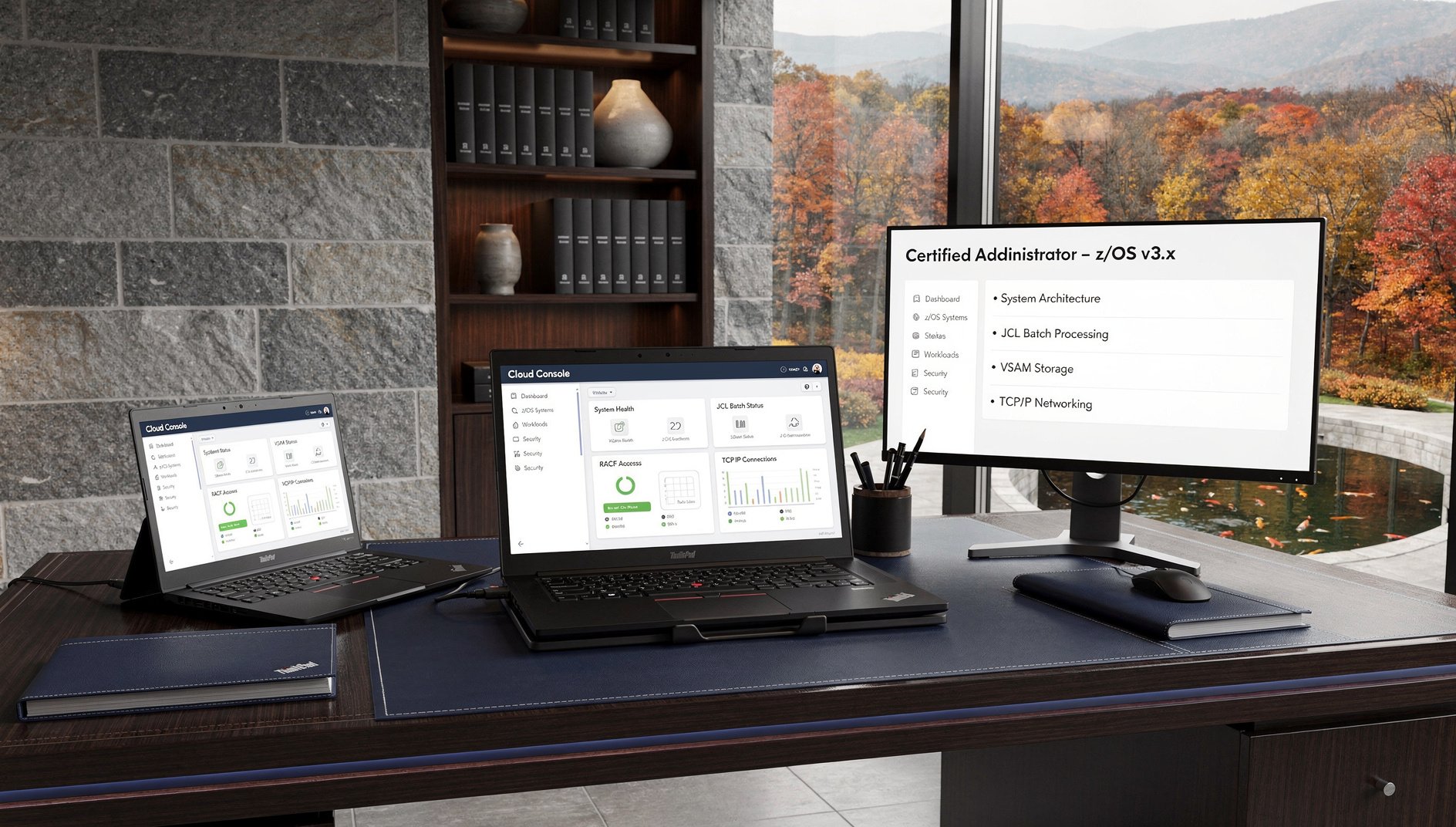
This course is in active development. Preview the scope below and create a free account to be notified the moment it goes live.
zOS Administrator
The exam validates a professional’s ability to configure, manage, and troubleshoot z/OS v2.5 system components, covering fundamentals, security, networking, workload management, and subsystem administration in enterprise environments, ensuring operational reliability.
Who Should Take This
System administrators, operations engineers, and support staff who have at least one year of experience with mainframe environments and a foundational knowledge of z/OS should pursue this certification. It prepares them to design, implement, and optimize system configurations, security policies, and workload controls, advancing their career toward senior system‑administration roles.
What's Covered
1Domain 1: z/OS System Fundamentals
2Domain 2: Security and RACF
3Domain 3: Network Configuration
4Domain 4: Workload Management
5Domain 5: Subsystem Administration
6Domain 6: System Maintenance and Recovery
What's Included in AccelaStudy® AI
Course Outline
1Domain 1: z/OS System Fundamentals 3 topics
System Architecture
- Implement z/OS system initialization using IPL procedures with SYS1.PARMLIB member configuration.
- Configure address space management with region sizes, memory objects, and 64-bit virtual storage.
- Analyze system resource utilization using RMF reports to evaluate CPU, memory, and I/O performance.
- Design workload partitioning strategies using LPARs and z/VM for isolation and resource optimization.
Job Management
- Implement JCL procedures for batch job submission with DD statements, EXEC PGM, and PROC invocation.
- Configure JES2 or JES3 subsystem parameters for job entry, scheduling, and output management.
- Analyze job execution failures using JCL error messages, system logs, and return code diagnostics.
Data Management
- Implement VSAM dataset creation and management using IDCAMS with DEFINE CLUSTER and REPRO commands.
- Configure SMS storage management with storage groups, management classes, and data class definitions.
- Analyze DASD volume utilization to plan dataset placement and implement space management policies.
2Domain 2: Security and RACF 3 topics
RACF Administration
- Implement RACF user and group profiles with attributes, authorities, and password policy configuration.
- Configure dataset, general resource, and program access controls using RACF PERMIT and SETROPTS.
- Analyze RACF audit records using SMF type 80 data to detect security violations and access anomalies.
- Design RACF security architecture with group hierarchies, role-based access, and delegated administration.
System Security
- Implement APF authorization for system libraries and configure PPT entries for privileged programs.
- Configure SSL/TLS certificate management using RACDCERT for secure communications on z/OS.
- Analyze security exposure reports to identify unauthorized access and excessive privileges.
Compliance and Audit
- Implement SMF recording configuration with record types, subtypes, and exit routines for monitoring.
- Configure RACF health checks using IBM Health Checker for z/OS with custom check definitions.
- Analyze compliance requirements to map RACF controls to regulatory frameworks like PCI-DSS and SOX.
- Design security monitoring architecture combining RACF, SMF, and SIEM integration for alerting.
3Domain 3: Network Configuration 3 topics
TCP/IP Configuration
- Implement z/OS Communications Server TCP/IP with PROFILE.TCPIP, resolver, and interface configuration.
- Configure VTAM and APPN network definitions for SNA connectivity and session management.
- Analyze network performance using NETSTAT, TRACERTE, and packet trace utilities for troubleshooting.
Network Security
- Implement AT-TLS policies for automated TLS encryption of TCP connections without application changes.
- Configure IP filtering rules and intrusion detection using Policy Agent and IDS components.
- Analyze network traffic patterns to design firewall rules and security zone architectures.
- Design secure network architectures with DMZ placement, VLAN segmentation, and encrypted tunnels.
File Transfer Services
- Implement z/OS FTP server configuration with CHROOT, access control, and audit logging.
- Configure OpenSSH on z/OS with key-based authentication, SFTP subsystem, and RACF integration.
- Analyze file transfer patterns to select between FTP, SFTP, Connect:Direct, and MQ for data exchange.
4Domain 4: Workload Management 3 topics
WLM Configuration
- Implement WLM service policies with service classes, workload classification rules, and performance goals.
- Configure WLM resource groups with CPU, storage, and I/O resource caps for workload isolation.
- Analyze WLM performance reports to evaluate service goal achievement and identify resource contention.
- Design WLM policies for mixed workloads balancing batch, online, and middleware requirements.
Sysplex Management
- Implement Parallel Sysplex configuration with coupling facility, XCF, and shared DASD connectivity.
- Configure sysplex workload distribution using WLM routing and dynamic VIPA for high availability.
- Analyze sysplex health using DISPLAY XCF and coupling facility activity reports to diagnose issues.
Automation
- Implement z/OS automation using System Automation with policy definitions and recovery actions.
- Configure automated operations with MPF message processing, WTOR replies, and scheduled procedures.
- Analyze automation coverage to identify manual tasks suitable for automated response.
- Design proactive automation strategies combining health monitoring, alerting, and self-healing.
5Domain 5: Subsystem Administration 3 topics
CICS Administration
- Implement CICS region configuration with SIT parameters, resource definitions, and connection management.
- Configure CICS monitoring using Performance Analyzer and CMF statistics for transaction analysis.
- Analyze CICS transaction dumps and logs to diagnose abends and performance degradation.
Db2 Administration
- Implement Db2 subsystem configuration with ZPARM settings, buffer pool sizing, and thread management.
- Configure Db2 utilities including REORG, RUNSTATS, COPY, and RECOVER for database maintenance.
- Analyze Db2 accounting and statistics trace data to optimize SQL performance and resource usage.
- Design Db2 data sharing configurations in Parallel Sysplex for high availability and scalability.
MQ Administration
- Implement MQ for z/OS queue manager configuration with queue definitions, channel setup, and security.
- Configure MQ clustering for message distribution and workload balancing across queue managers.
- Analyze MQ message flow using trace and event data to diagnose delivery failures and performance.
6Domain 6: System Maintenance and Recovery 3 topics
System Maintenance
- Implement SMP/E maintenance procedures for applying PTFs, APAR fixes, and service packs to z/OS.
- Configure ServerPac or CBPDO installation for z/OS version upgrades with coexistence planning.
- Analyze maintenance impact assessments to schedule fix application with minimal service disruption.
Backup and Recovery
- Implement DFDSS and DFSMShsm backup procedures for dataset-level and volume-level data protection.
- Configure automated backup schedules with management class policies and retention specifications.
- Analyze recovery scenarios to validate IPL from alternate volumes and dataset restoration procedures.
- Design disaster recovery plans for z/OS with GDPS and remote copy configurations.
Problem Determination
- Implement problem determination using SYSLOG, OPERLOG, LOGREC, and SVC dump analysis techniques.
- Configure diagnostic data collection with slip traps, GTF tracing, and component-specific traces.
- Analyze dump output using IPCS with VERBEXIT, SUMMARY, and component-specific formatting.
Scope
Included Topics
- All domains of IBM z/OS System Administrator (C1000-193).
- z/OS v2.5: JCL, RACF, WLM, TCP/IP, SMP/E, DFDSS.
- Subsystem administration: CICS, Db2, MQ on z/OS.
- Parallel Sysplex, security, networking, automation.
Not Covered
- Mainframe hardware engineering and LPAR microcode.
- Application development in COBOL, PL/I, or Assembler.
- Non-IBM mainframe operating systems.
- Cloud Pak for z/OS details.
Official Exam Page
Learn more at IBM
C1000-193 is coming soon
Adaptive learning that maps your knowledge and closes your gaps.
Create Free Account to Be Notified