This course is in active development. Preview the scope below and create a free account to be notified the moment it goes live.
QRadar SIEM Analysis
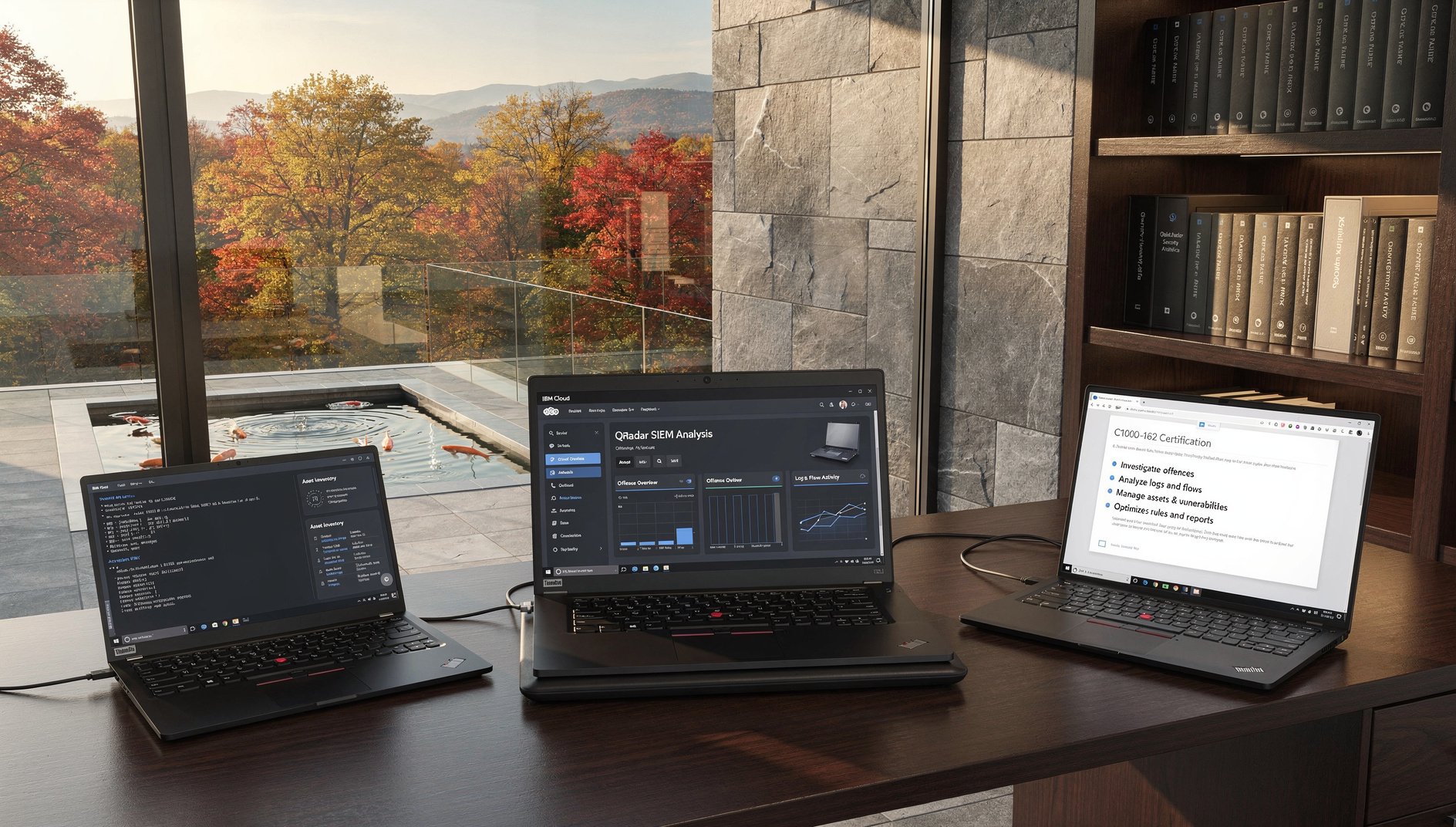
The C1000-162 certification trains professionals to investigate offenses, analyze logs, network flows, manage assets and vulnerabilities, and optimize QRadar rules and reports, ensuring effective SIEM deployment.
Who Should Take This
It is intended for security analysts, incident responders, and SIEM administrators who have at least one year of experience with IBM QRadar and seek to deepen their analytical and strategic capabilities. By mastering offense investigation, log and event correlation, network flow analysis, and asset‑vulnerability management, they can design, tune, and report on QRadar solutions that meet enterprise security objectives.
What's Covered
1Domain 1: Offense Investigation
2Domain 2: Log and Event Analysis
3Domain 3: Network Flow Analysis
4Domain 4: Asset and Vulnerability Management
5Domain 5: Rules, Reporting, and Optimization
What's Included in AccelaStudy® AI
Course Outline
1Domain 1: Offense Investigation 2 topics
Offense Management
- Configure offense investigation workflows including offense summary review, contributing events, and source-destination analysis.
- Implement offense management procedures including assignment, status tracking, closing, and false positive identification.
- Configure offense magnitude analysis including relevance, severity, and credibility scoring factors for threat prioritization.
- Analyze offense correlation chains to determine attack progression, lateral movement, and root cause of security incidents.
- Design offense investigation playbooks with structured analysis procedures, escalation criteria, and documentation standards.
Incident Analysis
- Implement threat indicator analysis using QRadar reference sets, reference maps, and threat intelligence feed integration.
- Configure MITRE ATT&CK framework mapping for offense categorization and attack technique identification in investigations.
- Implement timeline reconstruction using QRadar event and flow data for chronological attack sequence analysis.
- Analyze multi-stage attack patterns to identify initial access vectors, persistence mechanisms, and data exfiltration indicators.
- Design incident response procedures integrating QRadar offense data with external ticketing and orchestration platforms.
- Design a multi-tenant log source management architecture that isolates domain-level visibility while enabling cross-domain threat correlation.
2Domain 2: Log and Event Analysis 3 topics
Event Processing
- Configure log source parsing with DSM property extraction including custom regex patterns and event categorization mappings.
- Implement custom log source type creation for applications not supported by default QRadar DSM configurations.
- Configure event property extraction using custom parsing rules with regex, JSON, and XML extraction methods.
- Analyze event data patterns to identify parsing failures, miscategorized events, and log source configuration issues.
- Design log source onboarding procedures with standardized parsing validation, categorization review, and documentation.
Event Search and Filtering
- Implement AQL queries for event searching with WHERE clauses, aggregation functions, and time range filtering operations.
- Configure saved searches with scheduled execution, result actions, and dashboard integration for ongoing monitoring.
- Implement event viewer column customization and quick filter creation for efficient event investigation workflows.
- Analyze AQL query performance to optimize search execution time and reduce resource consumption on QRadar console.
- Recommend event aggregation and coalescing strategies to reduce storage consumption while preserving forensic fidelity for incident investigations.
Custom Event Property Extraction
- Configure custom event properties using regex-based extraction to parse non-standard log formats from third-party security appliances.
- Analyze parsed custom properties across correlated offense timelines to identify attack patterns not captured by default property mappings.
- Design a custom property extraction strategy that balances parsing accuracy, storage overhead, and query performance for high-volume event sources.
3Domain 3: Network Flow Analysis 3 topics
Flow Processing
- Configure flow analysis using QRadar flow viewer with source, destination, application, and protocol filtering parameters.
- Implement flow search queries using AQL for network traffic analysis including volume, duration, and application detection.
- Configure superflow analysis for aggregated flow data examination with nested flow exploration and detail extraction.
- Analyze network flow patterns to identify anomalous traffic, unauthorized communications, and data exfiltration indicators.
- Design network monitoring strategies using flow data for baseline establishment, anomaly detection, and capacity analysis.
Content Analysis
- Configure flow content capture analysis for deep packet inspection of reconstructed session content and payload examination.
- Implement application detection rules using flow data attributes for identifying network applications and protocols.
- Analyze captured content data to investigate data loss, policy violations, and malicious payload delivery in network traffic.
- Evaluate the effectiveness of custom correlation rules by comparing detection rates against known attack scenarios and false positive ratios.
- Recommend optimized rule testing methodologies that validate correlation logic against historical event data before production deployment.
Network Flow Analysis
- Configure QRadar network flow collection from NetFlow, sFlow, and IPFIX sources to capture traffic metadata for behavioral analysis.
- Analyze network flow data to identify lateral movement patterns, data exfiltration attempts, and anomalous communication channels.
- Design a network flow monitoring strategy that integrates flow data with event correlation to detect advanced persistent threats across network segments.
4Domain 4: Asset and Vulnerability Management 3 topics
Asset Management
- Configure QRadar asset reconciliation with automatic asset discovery from log sources, flow data, and vulnerability scanners.
- Implement asset profile customization with owner assignment, criticality classification, and custom property configuration.
- Configure vulnerability assessment integration with QRadar for correlating vulnerabilities with network events and offenses.
- Analyze asset risk scores combining vulnerability exposure, event activity, and asset criticality for remediation prioritization.
- Design asset management workflows with automated discovery, classification, and risk-based vulnerability prioritization strategies.
Risk Analysis
- Implement QRadar risk manager policies for network topology analysis and compliance rule violation detection.
- Configure domain-aware analysis for multi-tenant environments with network hierarchy and domain separation controls.
- Analyze network exposure and vulnerability data to assess organizational risk posture and identify critical remediation priorities.
- Evaluate offense lifecycle management practices including assignment workflows, escalation paths, and closure documentation requirements.
- Design an offense prioritization framework that incorporates asset criticality, vulnerability context, and threat intelligence to guide analyst response.
Compliance and Audit Reporting
- Configure QRadar compliance report templates for PCI-DSS, HIPAA, and SOX regulatory frameworks using built-in and custom report definitions.
- Analyze compliance report outputs to identify gaps in security monitoring coverage and log source collection across regulated data environments.
- Design an automated compliance reporting workflow that schedules report generation, distribution, and exception tracking for multi-regulation environments.
5Domain 5: Rules, Reporting, and Optimization 2 topics
Rule Management
- Configure custom event rules with multi-condition logic, threshold testing, and offense generation for specific detection scenarios.
- Implement anomaly detection rules using behavioral analysis, statistical baseline comparison, and deviation threshold alerting.
- Configure building block rules for reusable detection logic shared across multiple correlation and event rules.
- Implement rule testing and validation using historical event replay and offense simulation for detection accuracy verification.
- Analyze rule effectiveness by evaluating true positive rates, false positive frequency, and rule processing performance impact.
- Design detection rule libraries with organized categories, naming conventions, and lifecycle management for rule maintenance.
Reporting and Dashboards
- Configure QRadar reports with scheduled generation, multiple chart types, and distribution to stakeholders via email.
- Implement custom dashboards with aggregated views, real-time updates, and role-based visibility for SOC operations.
- Configure compliance reporting templates with regulatory framework mappings and automated evidence collection summaries.
- Analyze reporting requirements to design executive, operational, and compliance report packages for different stakeholder audiences.
Scope
Included Topics
- All domains of IBM Security QRadar SIEM V7.5 Analysis (C1000-162): offense investigation, log and flow analysis, asset management, rule tuning, and reporting.
- QRadar offense investigation: offense lifecycle, correlation, magnitude, source and destination analysis, and incident response workflows.
- Log source analysis: event parsing, property extraction, custom log sources, DSM configuration, and event categorization.
- Network flow analysis: flow processing, application detection, flow bias, superflow aggregation, and content capture analysis.
- Asset management: asset reconciliation, vulnerability assessment integration, risk scoring, and asset profiling in QRadar.
- Rule and search optimization: custom rule creation, AQL query development, saved searches, and performance tuning.
Not Covered
- QRadar installation procedures.
- Network hardware configuration.
- Non-IBM SIEM platforms.
- Operating system administration.
Official Exam Page
Learn more at IBM
C1000-162 is coming soon
Adaptive learning that maps your knowledge and closes your gaps.
Create Free Account to Be Notified