This course is in active development. Preview the scope below and create a free account to be notified the moment it goes live.
Aria Automation Professional
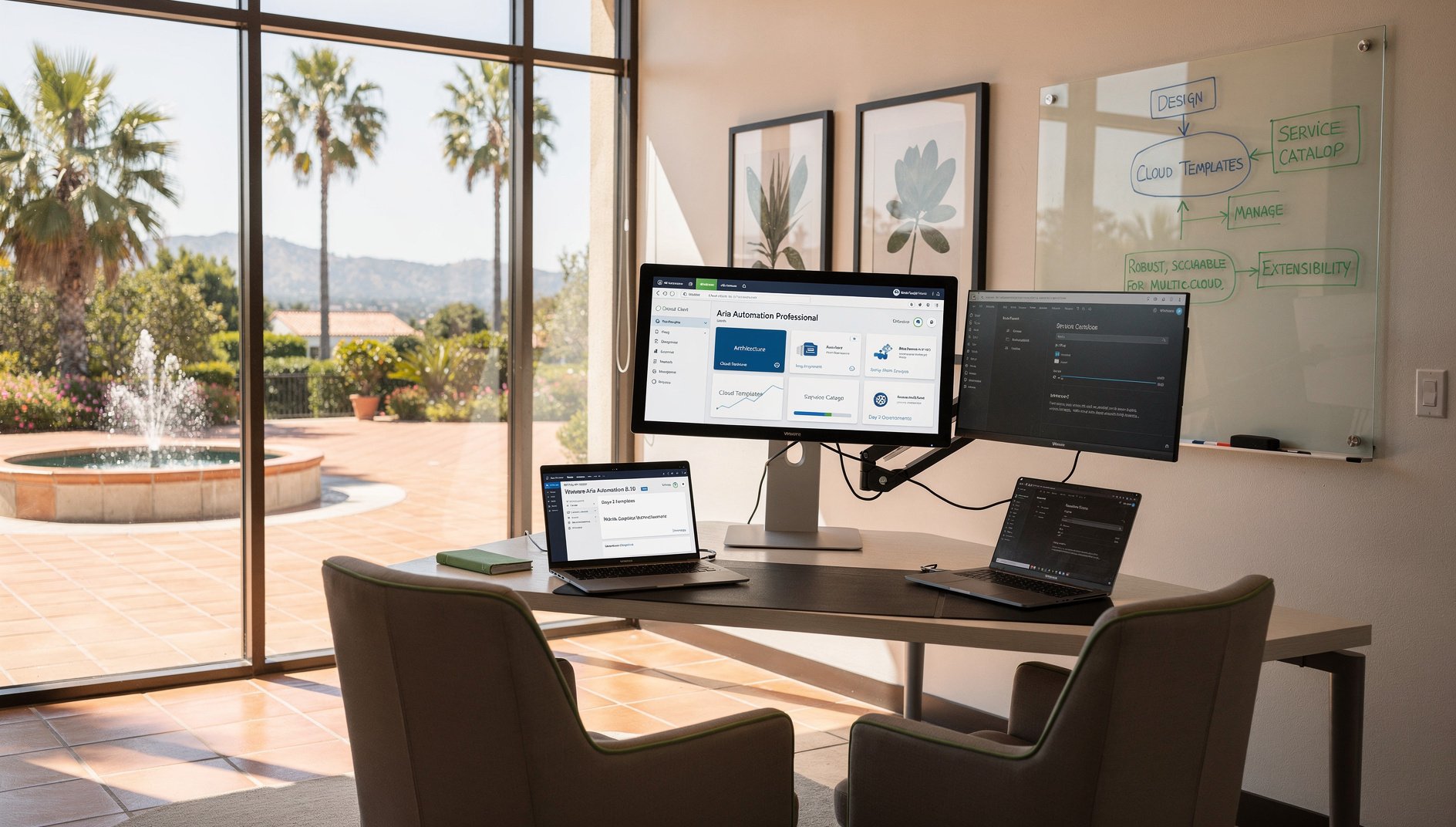
The course teaches professionals how to design, implement, and manage VMware Aria Automation 8.10 solutions, covering architecture, cloud templates, service catalog, extensibility, and day‑2 operations to ensure robust, scalable automation.
Who Should Take This
IT architects, senior engineers, and automation specialists who have at least two years of experience with VMware cloud products and seek to lead enterprise‑scale automation projects will benefit. They aim to deepen strategic design skills, optimize service delivery, and master ongoing operational governance within Aria Automation environments.
What's Covered
1Domain 1: Aria Automation Architecture
2Domain 2: Cloud Templates
3Domain 3: Service Broker and Catalog
4Domain 4: Extensibility
5Domain 5: Day-2 Operations
6Domain 6: Multi-Cloud and Integration
7Domain 7: Monitoring and Troubleshooting
What's Included in AccelaStudy® AI
Course Outline
1Domain 1: Aria Automation Architecture 2 topics
Platform Deployment
- Apply Aria Automation cluster deployment including load balancer configuration, certificate management, and Lifecycle Manager integration.
- Apply cloud account configuration connecting Aria Automation to vSphere, NSX, AWS, Azure, GCP, and VMware Cloud on AWS endpoints.
- Analyze Aria Automation sizing requirements based on concurrent deployments, catalog items, and user count for production environments.
- Analyze integration architecture between Aria Automation, Service Broker, Orchestrator, and Aria Operations for unified cloud management.
- Design an Aria Automation deployment architecture specifying clustering, load balancing, DR, and integration with enterprise identity systems.
Infrastructure Configuration
- Apply cloud zone configuration with placement policies, capability tags, and priority settings for multi-cloud workload placement.
- Apply flavor mappings, image mappings, and network profiles to abstract infrastructure differences across cloud endpoints.
- Analyze cloud zone placement decisions to troubleshoot workload deployment failures caused by tag mismatches or resource constraints.
- Analyze storage profiles, network profiles, and integration points with NSX for automated network provisioning.
- Design a multi-cloud infrastructure abstraction strategy using zones, profiles, and mappings for portable cloud template deployment.
2Domain 2: Cloud Templates 2 topics
Template Development
- Apply YAML cloud template authoring with resource types, properties, constraints, input variables, and computed outputs.
- Apply cloud template iterators, conditionals, and resource counting for dynamic multi-instance deployments.
- Analyze cloud template execution failures by examining deployment logs, resource provisioning errors, and constraint violations.
- Analyze property binding patterns between template resources for creating dependent multi-tier application deployments.
- Design cloud template libraries with modular templates, input schemas, and versioned content sources for enterprise IaC governance.
Template Governance
- Apply template versioning, release management, and content source integration with Git repositories for collaborative development.
- Apply property groups and custom properties to enforce organizational standards and inject configuration data into templates.
- Analyze template compliance with organizational naming conventions, tagging requirements, and security policies.
- Analyze the tradeoffs between monolithic templates and modular composable templates for enterprise environments.
- Design a template governance framework with version control, review workflows, testing procedures, and promotion pipelines.
3Domain 3: Service Broker and Catalog 2 topics
Catalog Management
- Apply Service Broker catalog configuration with content sources, catalog items, custom forms, and project-based entitlements.
- Apply custom form design with dynamic fields, validation rules, computed defaults, and conditional visibility for catalog requests.
- Analyze catalog item availability issues and entitlement conflicts preventing users from accessing provisioning services.
- Analyze content sharing patterns between projects and determine appropriate sharing policies for multi-team environments.
- Design a self-service catalog strategy with curated catalog items, custom forms, and streamlined request workflows for developer productivity.
Governance and Approval
- Apply approval policies with multi-level chains, conditional approvers, and timeout actions for catalog request governance.
- Apply lease policies, resource quotas, naming templates, and deployment limits to prevent resource sprawl and enforce standards.
- Analyze governance policy effectiveness using deployment audit trails and resource utilization reports.
- Analyze cost estimation integration for providing request-time cost visibility to requesters and approvers.
- Design a governance framework specifying approval chains, lease policies, quotas, and compliance reporting for enterprise cloud operations.
4Domain 4: Extensibility 2 topics
ABX and Event Subscriptions
- Apply ABX action development in Python, Node.js, or PowerShell for custom automation triggered by deployment lifecycle events.
- Apply event subscription configuration to trigger ABX actions, Orchestrator workflows, or webhooks on provisioning and day-2 events.
- Analyze ABX action execution logs, input/output payloads, and error traces to troubleshoot extensibility failures.
- Analyze event topic filtering and condition expressions to determine which subscriptions fire for specific deployment scenarios.
- Design an extensibility architecture specifying ABX actions, event subscriptions, and external integrations for custom automation workflows.
Orchestrator and Terraform
- Apply Aria Orchestrator workflow development for complex multi-step automation spanning VMware and third-party systems.
- Apply Terraform integration with Aria Automation for managing infrastructure using HCL alongside YAML cloud templates.
- Analyze Orchestrator workflow execution failures including action element errors, input binding issues, and exception handling.
- Analyze the tradeoffs between ABX actions, Orchestrator workflows, and Terraform for different automation complexity levels.
- Design an automation strategy selecting the appropriate tools (ABX, Orchestrator, Terraform, Ansible) for different use cases.
5Domain 5: Day-2 Operations 2 topics
Resource Management
- Apply day-2 resource actions including resize, reconfigure, snapshot, power management, and custom actions on deployed resources.
- Apply deployment-level actions including update (change template version), delete, change owner, and change lease for lifecycle management.
- Analyze resource reclamation opportunities using deployment utilization data and lease expiration reports.
- Analyze day-2 action execution failures caused by insufficient permissions, resource constraints, or template version incompatibilities.
- Design a day-2 operations strategy with resource governance, reclamation policies, and cost optimization automation.
Onboarding and Migration
- Apply resource onboarding to bring existing vSphere VMs under Aria Automation management with deployment association and policy enforcement.
- Apply plan-based migration to migrate deployments between cloud accounts, projects, or Aria Automation instances.
- Analyze onboarding compatibility issues including unsupported resource types, missing cloud zones, and tag mismatches.
- Analyze migration planning for large-scale Aria Automation upgrades with deployment data migration and configuration export/import.
- Design an onboarding strategy for bringing brownfield infrastructure under Aria Automation governance with minimal disruption.
6Domain 6: Multi-Cloud and Integration 2 topics
Multi-Cloud Operations
- Apply multi-cloud provisioning to deploy and manage workloads across vSphere, AWS, Azure, and GCP from unified cloud templates.
- Apply cloud-agnostic template patterns using constraints, tags, and mappings that deploy to any connected cloud endpoint.
- Analyze multi-cloud deployment consistency to identify configuration drift between identical workloads on different cloud providers.
- Analyze cloud-specific resource type limitations and map feature availability across vSphere, AWS, Azure, and GCP endpoints.
- Design a multi-cloud governance strategy with consistent policies, cost tracking, and compliance monitoring across all cloud endpoints.
Pipeline and GitOps
- Apply Code Stream (Aria Automation Pipelines) for CI/CD pipeline creation with stages, tasks, and integration endpoints.
- Apply GitOps patterns with Git-triggered pipelines, template version promotion, and environment-based deployment stages.
- Analyze pipeline execution failures including task errors, endpoint connectivity issues, and variable resolution problems.
- Analyze pipeline integration with container registries, Kubernetes clusters, and testing frameworks for end-to-end delivery.
- Design a CI/CD strategy using Aria Automation Pipelines with environment promotion, approval gates, and rollback capabilities.
7Domain 7: Monitoring and Troubleshooting 2 topics
Operational Monitoring
- Apply Aria Automation monitoring using deployment dashboards, event logs, audit trails, and system health indicators.
- Apply Aria Operations integration for tracking deployed resource utilization, cost, and compliance across managed environments.
- Analyze Aria Automation performance issues including slow provisioning, API timeouts, and cluster resource exhaustion.
- Analyze deployment cost trends and resource utilization to identify optimization opportunities across multi-cloud environments.
- Design an operational monitoring strategy for Aria Automation integrating health checks, utilization tracking, and cost management.
Platform Troubleshooting
- Apply Aria Automation troubleshooting using platform logs, provisioning traces, and API response analysis for failure diagnosis.
- Apply Aria Lifecycle Manager for Aria Automation upgrades, patches, and configuration management operations.
- Analyze cloud account connectivity failures, cloud zone health issues, and endpoint credential expiration problems.
- Analyze Aria Automation cluster health, database replication status, and load balancer configuration for platform stability.
- Design a platform maintenance strategy with upgrade procedures, backup schedules, and health monitoring for Aria Automation.
Scope
Included Topics
- Aria Automation architecture, cloud accounts, cloud templates, Service Broker, day-2 operations, extensibility (ABX, Orchestrator), Terraform integration, governance, and pipeline automation aligned to VCP-CMA.
- Multi-cloud provisioning, YAML templates, custom forms, approval workflows, property groups, ABX actions, event subscriptions, and Aria Orchestrator workflows.
Not Covered
- VCAP-level advanced design.
- Full Terraform/Ansible mastery.
- Public cloud native service configuration.
Official Exam Page
Learn more at VMware/Broadcom
2V0-31.24 is coming soon
Adaptive learning that maps your knowledge and closes your gaps.
Create Free Account to Be Notified