This course is in active development. Preview the scope below and create a free account to be notified the moment it goes live.
VCF Architect
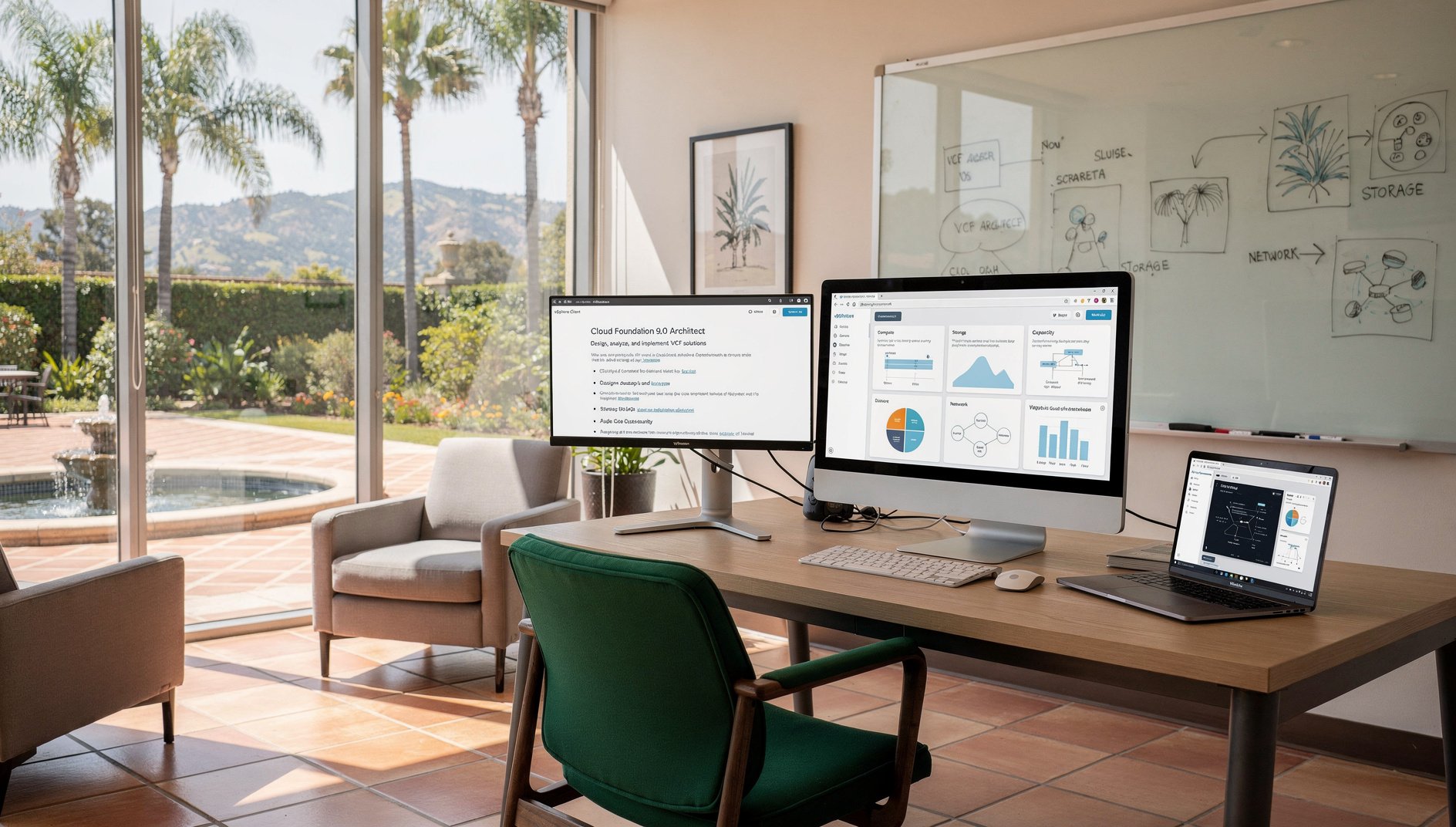
VMware Certified Professional - Cloud Foundation 9.0 Architect (2V0-13.25) teaches architects to design, analyze, and implement VCF solutions across compute, storage, network, and security, ensuring scalable, compliant cloud infrastructures.
Who Should Take This
It is intended for senior IT architects, cloud engineers, and solution designers with at least three years of experience deploying VMware Cloud Foundation. These professionals seek to validate their ability to create robust, secure, and compliant VCF architectures that align with enterprise strategy and operational efficiency.
What's Covered
1Domain 1: VCF Design Methodology
2Domain 2: Compute Design
3Domain 3: Storage Design
4Domain 4: Network Design
5Domain 5: Security and Compliance Design
6Domain 6: DR and Migration Design
7Domain 7: Operations Design
What's Included in AccelaStudy® AI
Course Outline
1Domain 1: VCF Design Methodology 2 topics
Design Process
- Apply VMware design methodology including requirements gathering, conceptual design, logical design, and physical design for VCF architectures.
- Apply stakeholder interview techniques to capture business requirements, constraints, assumptions, and risks for VCF design projects.
- Analyze business requirements to derive technical requirements including performance, availability, scalability, and security constraints.
- Analyze the impact of constraints (budget, timeline, existing infrastructure, skills) on VCF design decisions and tradeoff selection.
- Design a comprehensive VCF solution architecture document mapping business requirements to technical design decisions with justification.
Capacity Planning
- Apply capacity planning methodology to size VCF management and workload domains based on current workloads and projected growth.
- Apply compute, storage, and network sizing calculations for VCF clusters considering overhead, HA capacity, and headroom requirements.
- Analyze workload characterization data (CPU, memory, IOPS, network) to determine appropriate cluster configurations and host specifications.
- Analyze the tradeoffs between scale-up (larger hosts) and scale-out (more hosts) approaches for VCF cluster sizing.
- Design a capacity plan for VCF including initial sizing, growth projections, procurement triggers, and expansion procedures.
2Domain 2: Compute Design 2 topics
Cluster Architecture
- Apply compute cluster design principles including host count, CPU/memory ratios, and N+1 availability for VCF workload domains.
- Apply DRS configuration design including automation levels, affinity rules, and resource pool hierarchies for workload isolation.
- Analyze compute requirements for different workload types (general, database, GPU, HPC) to determine appropriate host configurations.
- Analyze the impact of CPU generation mixing on EVC mode, DRS migration capability, and workload performance.
- Design a multi-cluster compute architecture for VCF with appropriate host specifications, cluster sizing, and resource governance.
Availability Design
- Apply HA design principles including admission control policy selection, restart priority configuration, and failure response automation.
- Apply stretched cluster design for cross-site availability including witness placement, network latency requirements, and storage considerations.
- Analyze availability SLA requirements to determine appropriate combination of HA, FT, stretched clusters, and site recovery.
- Analyze failure domain design including rack awareness, power distribution, and network path redundancy for infrastructure resilience.
- Design a high availability architecture for VCF specifying cluster configuration, failure domains, and recovery procedures for stated SLAs.
3Domain 3: Storage Design 2 topics
vSAN Architecture
- Apply vSAN design principles including architecture selection (ESA/OSA), disk group configuration, and fault domain layout.
- Apply vSAN storage policy design mapping workload requirements to FTT, fault tolerance method, and performance tier settings.
- Analyze vSAN sizing requirements including raw capacity, usable capacity after FTT overhead, and performance benchmarks.
- Analyze vSAN network requirements including dedicated VLAN, bandwidth, multicast/unicast, and MTU settings for optimal performance.
- Design a vSAN architecture for VCF selecting ESA versus OSA, sizing fault domains, and defining policies for mixed workload requirements.
External Storage Integration
- Apply external storage design principles for VCF including FC SAN, iSCSI, NFS, and vVol integration options.
- Apply storage tiering design using SPBM policies to automate workload placement across performance tiers.
- Analyze the tradeoffs between vSAN-only and hybrid storage architectures considering performance, cost, and management complexity.
- Analyze supplemental storage use cases within VCF for workloads requiring specific storage features (snapshots, replication, dedup).
- Design a storage architecture for VCF combining vSAN principal storage with supplemental external storage for specialized workload requirements.
4Domain 4: Network Design 2 topics
Physical and Logical Networking
- Apply VCF network design principles including VLAN allocation, IP addressing scheme, BGP AS numbering, and MTU configuration.
- Apply multi-rack network design for VCF considering spine-leaf topology, rack switch requirements, and inter-rack bandwidth.
- Analyze network bandwidth requirements for management, vMotion, vSAN, overlay, and uplink traffic to size physical network infrastructure.
- Analyze network redundancy design including dual ToR switches, diverse uplink paths, and BGP failover for management and workload traffic.
- Design a VCF network architecture specifying physical topology, VLAN plan, IP scheme, and BGP configuration for multi-rack deployment.
NSX Design
- Apply NSX design principles for VCF including transport zone layout, edge cluster sizing, and gateway routing architecture.
- Apply NSX security design including micro-segmentation policy hierarchy, security group strategy, and IDS/IPS deployment.
- Analyze NSX edge cluster sizing requirements based on throughput, service count, and redundancy needs for VCF workload domains.
- Analyze the tradeoffs between single large NSX domain versus multiple smaller domains for VCF tenant isolation.
- Design an NSX architecture for VCF specifying transport zones, edge placement, routing topology, and security policy framework.
5Domain 5: Security and Compliance Design 2 topics
Security Architecture
- Apply security design principles for VCF including defense-in-depth, zero-trust, and least-privilege access models.
- Apply RBAC design for VCF specifying role definitions, permission scope, and identity source integration for administrative access.
- Analyze regulatory compliance requirements (PCI DSS, HIPAA, SOC 2) and map them to VCF security configuration requirements.
- Analyze encryption design requirements including KMS architecture, key rotation, and the scope of encryption (VM, vSAN, vMotion).
- Design a VCF security architecture specifying access control, encryption, micro-segmentation, and compliance monitoring.
Certificate and Identity Design
- Apply certificate architecture design for VCF including CA hierarchy, certificate types, and lifecycle management procedures.
- Apply identity management design integrating Active Directory, LDAP, or SAML identity providers with vCenter SSO for VCF.
- Analyze certificate management complexity and determine the optimal CA strategy (VMCA, enterprise subordinate CA, or custom CA).
- Analyze multi-factor authentication options for administrative access to VCF components.
- Design an identity and certificate management architecture for VCF specifying CA hierarchy, rotation schedules, and MFA integration.
6Domain 6: DR and Migration Design 2 topics
Disaster Recovery
- Apply DR design principles for VCF including RPO/RTO analysis, recovery site architecture, and failover automation.
- Apply VCF backup design specifying backup targets, schedules, retention policies, and restore procedures for all critical components.
- Analyze DR topology options (active-active stretched, active-passive, pilot light) and their cost, complexity, and recovery time tradeoffs.
- Analyze network design requirements for DR including IP mobility, DNS failover, and load balancer reconfiguration during site failover.
- Design a comprehensive DR strategy for VCF specifying recovery site topology, data replication, failover procedures, and testing schedule.
Migration Design
- Apply migration design principles for moving workloads to VCF from legacy vSphere, physical servers, or other cloud platforms.
- Apply VMware HCX architecture for bulk migration, live vMotion, and network extension between source and VCF destination.
- Analyze migration wave planning considering application dependencies, downtime windows, and validation requirements.
- Analyze the tradeoffs between cold migration, warm migration (HCX bulk), and live migration (HCX vMotion) for different workload types.
- Design a migration plan for VCF adoption specifying assessment, wave planning, migration method, and validation for each workload group.
7Domain 7: Operations Design 2 topics
Day-2 Operations
- Apply operations design principles for VCF including monitoring strategy, alerting thresholds, and escalation procedures.
- Apply Aria Suite integration design for VCF operations including Aria Operations dashboards, Aria Logs, and Aria Automation catalogs.
- Analyze operational workflow requirements for VCF including change management, patch management, and capacity management processes.
- Analyze the tradeoffs between manual operational procedures and automated orchestration for VCF lifecycle tasks.
- Design a VCF operations framework specifying monitoring, alerting, automation, and process documentation standards.
Upgrade and Lifecycle Design
- Apply VCF upgrade design principles including staged rollout, pre-check validation, maintenance windows, and rollback procedures.
- Apply VCF interoperability matrix analysis to determine compatible component versions for upgrade planning.
- Analyze upgrade sequencing dependencies across VCF components (SDDC Manager, vCenter, ESXi, NSX, vSAN) to determine correct order.
- Analyze the impact of skipped releases and version gaps on upgrade path complexity and supportability.
- Design a VCF lifecycle management strategy specifying upgrade cadence, testing procedures, and version governance policies.
Scope
Included Topics
- VCF 9.0 architecture design, capacity planning, workload domain design, network architecture, storage design, security architecture, DR planning, and migration strategy aligned to VCP-VCF Architect.
- Conceptual, logical, and physical design for VCF environments including management domain, workload domains, NSX, vSAN, and Aria Suite integration.
Not Covered
- Implementation-level configuration at admin depth.
- Third-party specific hardware and software integration details.
Official Exam Page
Learn more at VMware/Broadcom
2V0-13.25 is coming soon
Adaptive learning that maps your knowledge and closes your gaps.
Create Free Account to Be Notified